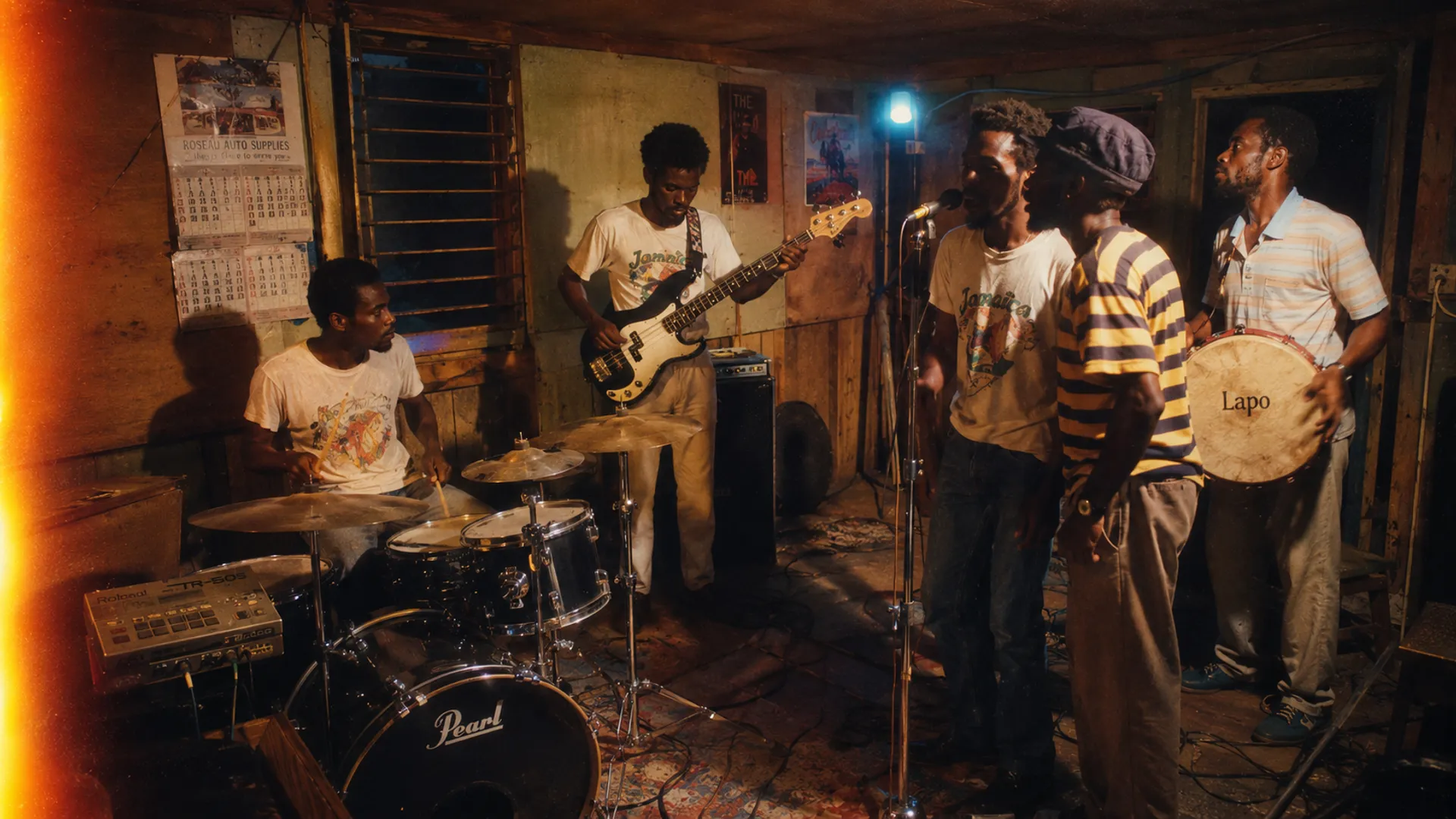


In short. Between 1988 and 1996, the band WCK founds the grammar of Bouyon in Roseau (Dominica). The recipe: three local roots (cadence-lypso at 95 BPM, jing ping on accordion, lapo kabwit goatskin drums) + two Anglophone contributions (Trinidadian soca, Jamaican dancehall) plugged into a Roland TR-505 drum machine that holds 152 BPM tirelessly. In 1995, Skinny Banton arrives and opens the bouyon-muffin sub-genre.
WCK Sets the Table
At the end of the previous chapter, One More Sway came out in 1988. The seed lands on soil prepared for ten years. We now need to tell who is in the room when that seed germinates, and how, over eight years, a band turns an intuition into a language.
You may have discovered Bouyon through a TIITII NBA single, at a party in Pointe-à-Pitre, or via a TikTok Reel, and you're wondering why the genre sounds the way it does. You're in the right place: this chapter unpacks the WCK grammar ingredient by ingredient, what comes from which root, what changes when the machine arrives, and how Skinny Banton tips the voice into the center of the mix. By the end, you'll know why a Bouyon single is recognizable in two bars.
The band is called WCK. Three letters for Windward Caribbean Kulture, the windward islands, Caribbean culture, and a K that marks the break with academic codes. It forms in Roseau, Dominica, in 1988. Not a Roseau studio, not a foreign label. A rehearsal room in the south of a small island.
At the heart of the lineup, two figures stand out. Derek "Rah" Peters is tied to the invention or the founding use of the word Bouyon, that is the most solidly documented version to date. Cornell "Fingers" Phillip gives this new energy its sonic shape: keyboards, programming, arrangement, musical direction, studio. Several other members and close collaborators take part in expanding the band vocally and instrumentally: Naye / Nayee, Mr Delly, Brenton Vidal, and others whose individual profiles still need to be documented with precision. Within this core, you also find a percussionist holding a lapo kabwit, the goatskin drum of the Creole carnival, a root WCK refuses to leave to the past.
Public sources converge on Derek Peters and Cornell Phillip as the architects; the other names appear in credits without always specifying when each one joined the band.
WCK does not arrive in a vacuum. RSB. Roots Stems and Branches, has been active since 1986 with titles like Alive, Break Loose and Kadanse'. First Serenade carries the band tradition in Pointe Michel. These groups belong to a period when Creole sounds are starting to harden, to accelerate, to clear space for a new popular form. WCK is not the only one searching. It has something the others don't have yet: it lays down a grammar.
The economic context helps. The Roseau carnival draws trucks loaded with sound systems every year. Neighborhood sound systems. Pottersville, Goodwill, Fond Cole, broadcast reggae, cadence-lypso, and soon what WCK is recording. The cassette market circulates from neighborhood to neighborhood. A drum machine arrived in Roseau in 1986, the TR-505, and three years later, nobody plays without a drum machine in the setup.
Five musicians, a rehearsal room, a borrowed drum machine. The WCK kitchen is in place. But what ingredients is it mixing?
The Local Roots
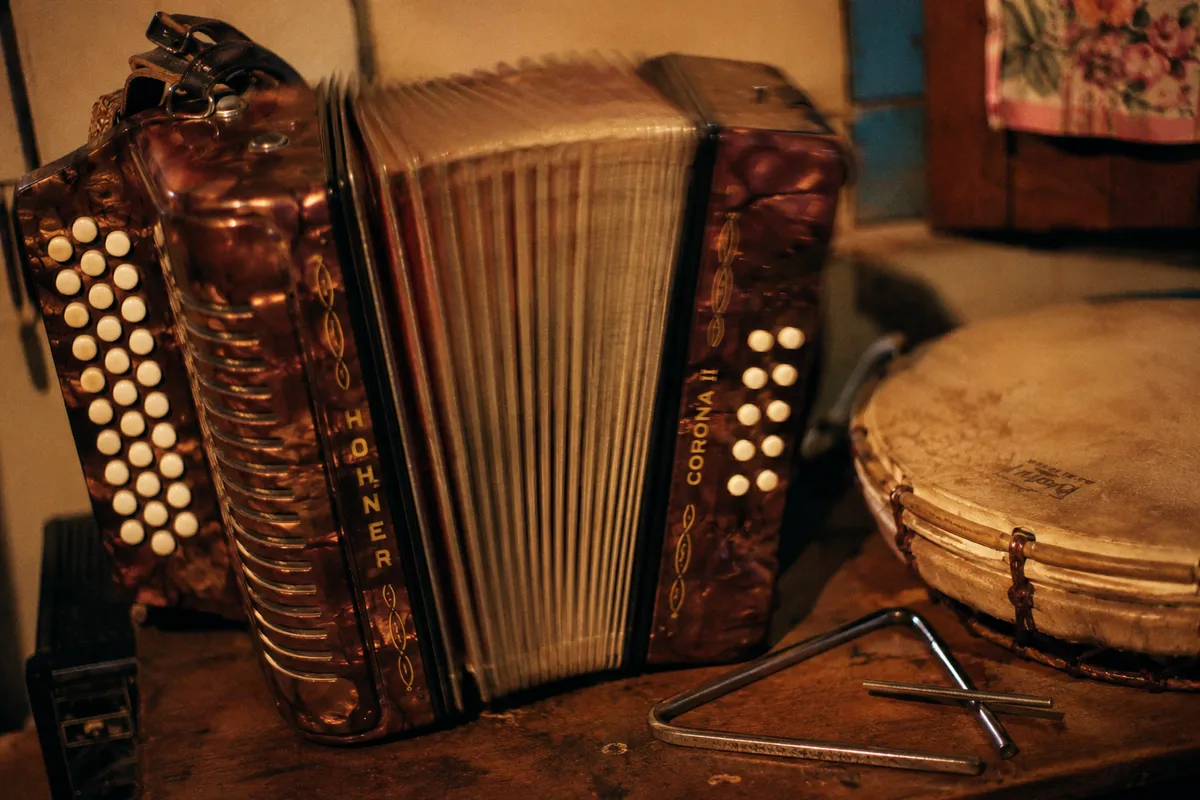
The answer fits in three Dominican words: cadence-lypso, jing ping, lapo kabwit. Three roots, three sonic territories, three different memories that WCK decides to put in the same pot. None of them is invented by the band. All of them are already there, in Dominica, in 1988. The WCK move is to recognize them as raw material, not as folklore to display, but as living grammar to plug into the mixer.
The first root is cadence-lypso. The genre is Dominican, and it carries the signature of Gordon Henderson and his band Exile One since the 70s. Henderson builds his cadence by crossing three ingredients: Trinidadian calypso, Haitian kompa, and jazz colors. The reference tempo runs around 95 BPM, a tempo for close, held, settled dancing. For WCK, this heritage is not a diffuse influence: it is the harmonic matrix. The chord progressions, the place of the horns, the role of the keyboard in the mix, all of it comes from cadence. Bouyon does not reinvent the grammar. It takes it, and it pushes it to 152 BPM, about 60% faster than the cadence tempo. It is a decision of continuity.
The second root is jing ping. The word designates the traditional music of the island, transmitted since the colonial period in the rural communities of the south. The classical lineup rests on four instruments: the accordion (introduced by European missionaries in the 19th century), the drum, the triangle that marks the metallic offbeat, and the shak-shak. Jing ping accompanies weddings, Pentecost celebrations, plantation feasts, wakes. It is functional music, played standing, without amplification, in spaces where ear and body sync without technical intermediary. WCK pulls jing ping out of weddings and plugs it into the mixer. The accordion motif gets transposed onto the synthesizer. The triangle's pulse moves into the TR-505's hi-hat. The neighborhood-feast culture, standing, collective, no stage, passes whole into the logic of Bouyon.
The third root is lapo kabwit. The name says the thing: lapo kabwit, the goatskin. A family of Dominican drums, goat skin stretched on a wooden shell, dry and deep timbre, capable of carrying over long distances in the open air. It is the ceremonial instrument of the island, played for centuries in neighborhood feasts and carnival processions. Lapo kabwit is not a soloist. It is played in groups, with several drums of different ranges, in call-and-response, with a leader who dictates the variations and a base that holds the pulse. When WCK integrates it in Roseau in 1988, the gesture is deliberate. The founders do not want to make pure electronic music. They want a genre that speaks to Dominica. Lapo kabwit brings three things the machine cannot do: a ritual anchor recognized by the whole island, a pre-electronic call-and-response grammar, and a cultural legitimacy that says we don't copy Kingston, we speak from here.
This integration does not happen in the mode of juxtaposition. WCK does not place a drum sample next to a machine beat. The percussionist plays with the TR-505 in the same room. The machine runs at 152 BPM, tireless. The human drummer lays down the accents, the variations, the breaths. It is this tension between mechanical regularity and human irregularity that gives early Bouyon its unique texture. The genre does not erase tradition, it makes it dialogue with electronics, in the same time, in the same tempo, in the same title.
WCK's intelligence, in 1988, is to have understood that modernity is not forgetting. Many Caribbean musics of the 80s abandon their roots to resemble American productions. WCK does the opposite. The band takes the most contemporary machine, the TR-505, and plugs it into what the island has that is most ancient. The result is neither a museum, nor a copy. It is a kitchen.
Three Dominican ingredients. But WCK also opens its kitchen to the wider Anglo-Caribbean world. That's where the tension begins.
The Anglophone Influences
WCK does not work in a vacuum. At the end of the 80s, two Anglophone musics cross the Caribbean with a force nobody can ignore. The first comes from the south: Trinidadian soca. The second comes from the north: Jamaican dancehall. Both reach Dominica through cassettes, radios, the Roseau sound systems, and through the diaspora that circulates between Roseau, Brooklyn, Toronto and London. No Dominican musician of this period can say "I don't listen to that." Bouyon is born in this saturated environment.
Soca poses the sharpest problem. The genre is born in Trinidad in the 70s under Lord Shorty's impulse, who contracts the words soul and calypso, the soul of calypso. The idea is to modernize classic calypso, to accelerate it, to adapt it to a generation that listens to American soul and funk. In the 80s, soca becomes the official music of the Trinidadian carnival. Every February, the soca monarchs compete in Port of Spain in contests that pace the Caribbean carnival season. When WCK forms in Roseau in 1988, the Dominican audience knows soca, dances to it, expects it. The Roseau carnival broadcasts Trinidadian hits on the sound systems as if they were local products.
That is where pressure peaks. The Anglophone Caribbean, in the 80s, already operates as a musical market dominated by the big economies. Trinidad for soca, Jamaica for reggae and dancehall. The small islands have a simple choice to make: follow, or invent. Several of Dominica's neighbors followed. They produced sub-genres that resemble the soca of Port of Spain, played with fewer means, with no signature of their own. These musics exist and tour, but they don't carry a territory's name.
WCK takes another bet. The band accepts soca as an ingredient, not as a model. The distinction is fundamental. A model gets imitated, you try to sound like Machel Montano. An ingredient gets mixed in, you take the carnival energy of soca, you take its fast tempo, you take its festive logic, and you set them next to jing ping, cadence-lypso and lapo kabwit. The result is not a Dominican soca. It is a new genre, which owes something to soca without being a derivative of it. Bouyon takes soca's energy, and anchors it in a Dominican grammar that Trinidadian soca does not possess.
The nuance matters. WCK is not on a crusade against soca. The band does not organize a frontal identity resistance. Several WCK members listen to and respect Trinidadian soca; some Bouyon singles of the 90s contain explicit rhythmic nods to the soca phrasing. But the underlying strategy stays the same: bring the guest to the table without handing them the menu. Bouyon's dosage gives more space to the Dominican roots than to the Trinidadian inputs. If you remove jing ping and lapo kabwit from the mix, what remains is a slightly aggressive soca. If you remove soca, what remains is a Dominican genre that holds together. The center of gravity is local.
The second Anglophone contribution is Jamaican dancehall. The previous chapter already laid this out: Roseau's sound systems have been broadcasting reggae and dancehall since the 80s, and the Dominican audience is educated to those heavy basses and fast tempos well before Bouyon arrives. WCK inherits this familiarity. But the band absorbs above all two precise things from dancehall. The first is the concept of the riddim, an instrumental built once and reused for several successive voices. This logic is foreign to cadence-lypso, which produces self-contained singles with their own arrangements. But it settles naturally into Bouyon's mechanics: the TR-505 runs at 152 BPM, tireless, and several singers can come lay down on it. The second is dancehall's vocal grammar, the short phrasing, the direct tone, the toaster's authority over the crowd. WCK adapts it to Dominican Creole and makes it unrecognizable.
The asymmetry between the two Anglophone influences is telling. Soca threatens identity, because it targets the same carnival use as Bouyon, on the same Caribbean geographic territory. Dancehall does not threaten, because Jamaica is culturally more distant, and because the riddim is a structural tool, not a genre that demands imitation. WCK therefore manages two different risks with two different strategies. With soca: integrate while keeping the Dominican center. With dancehall: adopt the mechanism without copying the sound.
This double operation assumes a musical awareness rare for a small band on a small island at the end of the 80s. WCK did not write a theoretical manifesto. But the choices you hear in the early productions tell a coherent strategy: refuse no one, become no one. It is the opposite of a defensive posture. It is the posture of a confident cook who knows their pot can welcome foreign ingredients without losing its original taste.
It remains to be seen whether the analysis holds when confronted with sources. Honesty requires saying it: no known public document records WCK's founders explicitly declaring "we want to integrate soca without dissolving into it." This strategic reading is an a posteriori interpretation, based on listening to the singles, on the composition of the mix, and on the fact that the genre established itself as recognizably Dominican rather than as a regional variant of soca. If a future interview contradicts this analysis, it will need revising. For now, this is the reading most coherent with what Bouyon produced.
WCK has decided to invite soca and dancehall to its table. The question is how to cook this mix. The machine will decide.
The Machine: what WCK does with it at Roseau
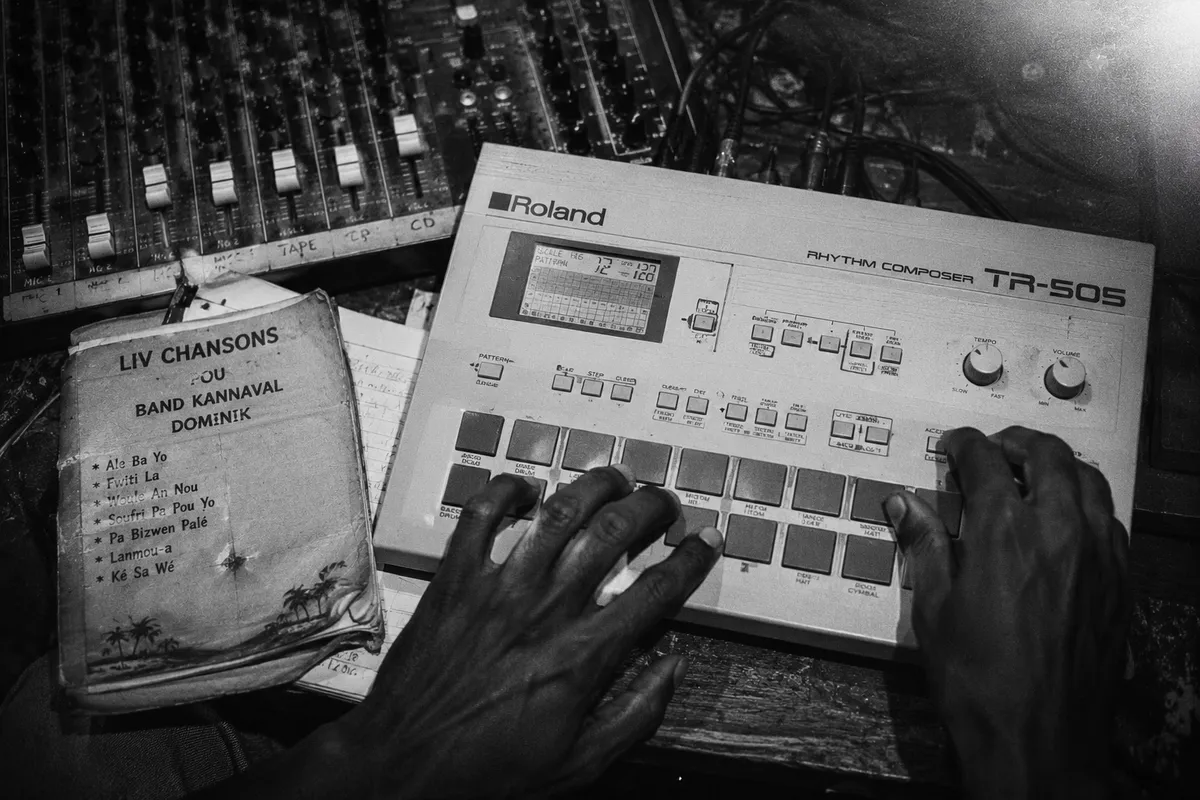
The TR-505 has been in the room since 1986. The previous chapter already told the story of its arrival in Roseau. Mr Delly's version of the trip to Trinidad, the internal version of the New York gift, the two coexisting. What matters here is no longer the origin. It is what WCK decides to do with it in Roseau, two years later.
The basic technical fact is simple. The TR-505 plays at 152 BPM for as long as you ask it to. It does not tire, does not run away, does not slow down when the drummer is thirsty. A Dominican carnival session demands long titles: seven to ten minutes of continuous loop, with no break, to hold the procession and the crowd. No human drummer holds that format. The machine does. It is the technical condition without which Bouyon would not have its form.
At the end of the 80s, in the lesser Caribbean, the standard answer to this fact is erasure. You have the machine, so you thank the drummer. You program a pattern, you loop it, you sing on top. It is simpler, it is cheaper, it is what most of the soca productions of the period do. The result holds the dance but loses the human grain, the breath between hits, the accent that shifts a quarter pulse, the fatigue that turns into variation.
WCK takes the opposite bet. The percussionist stays in the room. The live drum kit stays plugged into the mixer. The TR-505 replaces no one, it lays down a frame. It holds the tireless 152 BPM, and the human drummer plays on top, in the same title, in the same tempo. What the machine gives is the metronomic rigor. What the drummer keeps is the human groove: the accents you displace on purpose, the fills that answer a singer, the way you push a break on a crowd's shout. The two logics share the same audio mix.
This choice seems obvious today. It is not in 1990 in the Anglophone Caribbean. Many neighboring groups, in the same period, swing entirely toward programming and dissolve their living rhythm section. WCK refuses that swing. The Bouyon kitchen rests precisely on this asymmetry: a stable mechanical base, and an organic layer that negotiates with it. Without the machine, you lose the carnival tempo. Without the drummer, you lose the warmth. The band keeps both.
There is a direct consequence for the singers. When the TR-505 runs at 152 BPM with no drift, the singer can lay down long phrases, sometimes up to sixteen bars, without having to watch the tempo. They know the pulse will be the same at the start and the end of their phrase. The machine takes charge of the rigor; they focus on the narrative, the Creole, the vocal authority. Cadence-lypso, played entirely by humans at 95 BPM, does not allow the same calm, there is always a half-float to correct along the way. The machine offers Bouyon's voices a floor that does not move.
This same property is what makes the riddim installed at the end of the previous section possible. If the machine holds the same tempo from one title to another, you can record the instrumental base just once and bring three, four, five singers back over it on separate takes. This is exactly what the Jamaican dancehall mechanics learned to do, and exactly what the TR-505 makes reproducible in Roseau. The Bouyon language is no longer an isolated single. It is a platform on which several voices can come lay down in a chain.
Three years after the machine's arrival, no active group in Roseau plays without a drum machine in the setup. WCK is no longer alone in using the TR-505, but the band is the only one to have married it to a live drummer and a lapo kabwit percussionist in the same room. It is this superposition that signs the sound.
The machine is in place. The rhythm is locked. One thing is still missing for the language to become recognizable: a voice that sticks in the head.
Skinny Banton Arrives
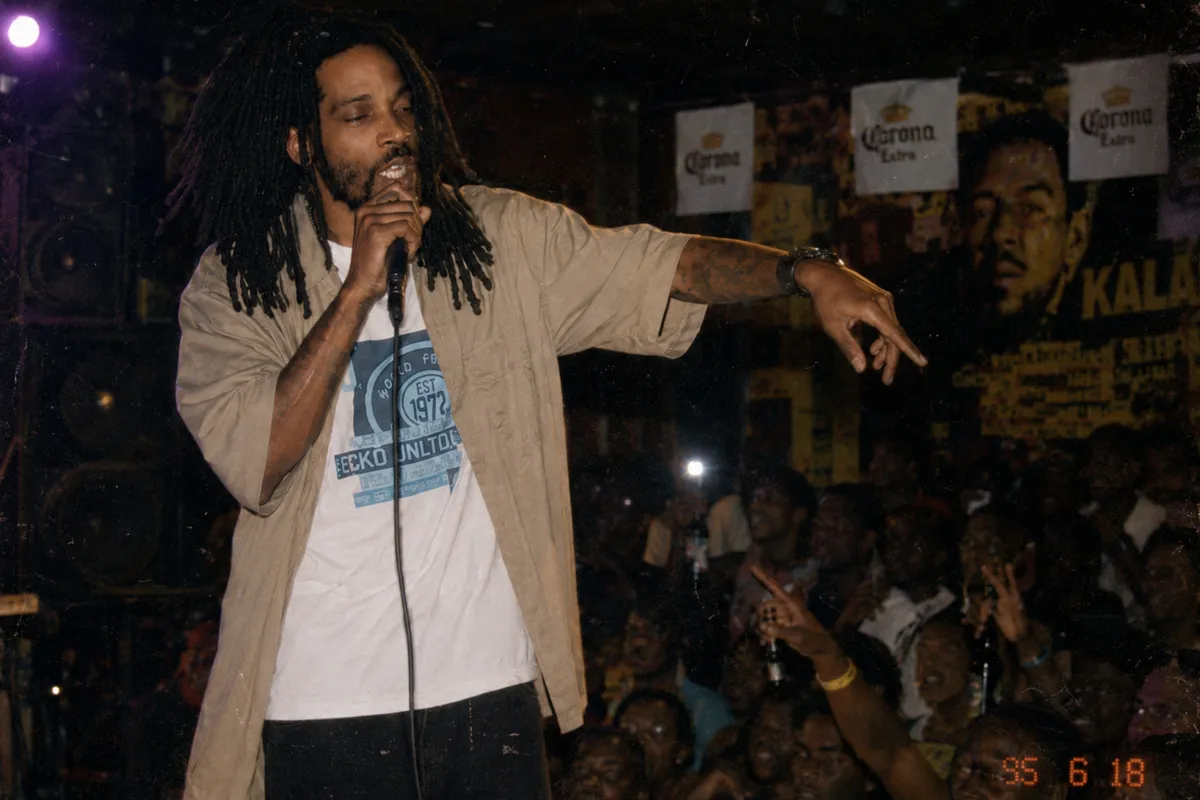
Skinny Banton is born in Dominica. On stage, he takes the alias Shadowflow first, then Skinny Banton, the one that will stick. The project has existed since 1993. He joins the WCK matrix around 1995, the exact date is contested depending on the sources, some credits speak of a progressive integration started earlier, others of a formalization after the 1995 carnival. What is documented is that, from this window onward, the band's sound changes. A color settles in that wasn't there before.
A homonym needs to be cleared up right away. The Dominican Skinny Banton is not the Grenadian Skinny Banton, the soca artist from Grenada, author of Wrong Again in 2019 and Water in 2023. Same stage name, no shared career, no documented collaboration. When you talk about Bouyon and WCK, you are talking about the Skinny Banton from Dominica.
What Skinny brings is a specific vocal color. Before him, Bouyon singers lay down Creole on the pulse of the TR-505 in a logic inherited from cadence-lypso and jing ping, a melodic grammar, sustained choruses, a phrasing that sings. Skinny lays down something else. He lays down Jamaican ragga toasting and the dancehall phrasing that is short, percussive, authoritative. The voice stops accompanying the machine, it commands the machine. It is a hierarchy shift in the mix: the rhythm stays, but it now serves a vocal narrative that decides.
This vocal graft opens a new territory in the Bouyon cartography. We will call it bouyon-muffin. The sub-genre stands out for two precise things. First, the dancehall-ragga vocal color, already described. Second, a more moderate tempo window. 110 to 135 BPM, instead of the 152 BPM of the WCK base and the ~160 BPM of modern hardcore Bouyon. This breathing room is not a slowdown: it is space for the voice. Bouyon-muffin gives the singer time to lay down their syllables and hold the toaster's authority without running after the pulse.
Skinny pushes the logic further and opens a sub-current inside the sub-genre. This sub-current is called raasuka. The difference is a question of vocal attack, not of tempo. Standard bouyon-muffin lays down ragga toasting; raasuka hardens the delivery, makes the phrasing rougher, more rhythmic, less melodic. Singing becomes a percussion instrument in its own right. Skinny does not separate the two lines at the moment he invents them, it is listening back that lets us trace the boundary between the standard branch and the raasuka branch.
The question of invention remains legitimately contested. The WCK side holds: without the TR-505 at sustained tempo, without the drum machine + lapo kabwit cohabitation, without the keyboards in place before 1995, a singer alone would never have produced the sub-genre. The Skinny side holds too: without the dancehall-ragga color, without the toaster attack, without the shift of the single's center of gravity toward the voice, you don't have bouyon-muffin, you only have the prior WCK base. The caricature "WCK did everything" erases the singular vocal contribution. The caricature "Skinny did everything" erases the collective kitchen. Both miss the essential: bouyon-muffin is born from an encounter, not a signature.
The retrospective formalization arrives much later. In 2010, the compilation Best of Skinny Banton « Bouyon Muffin » is released, twenty-two singles that gather the pieces that defined the line. This Spotify release does not create the genre. It records it, names it, makes it audible as a coherent object fifteen years after the fact. For the new generations who discover Bouyon in the 2010s, it is through this compilation that the word bouyon-muffin exists.
1995. The machine, the drums, the ingredients, the voice. WCK has it all. The loop just needs to close.
1996, the Language Is Complete
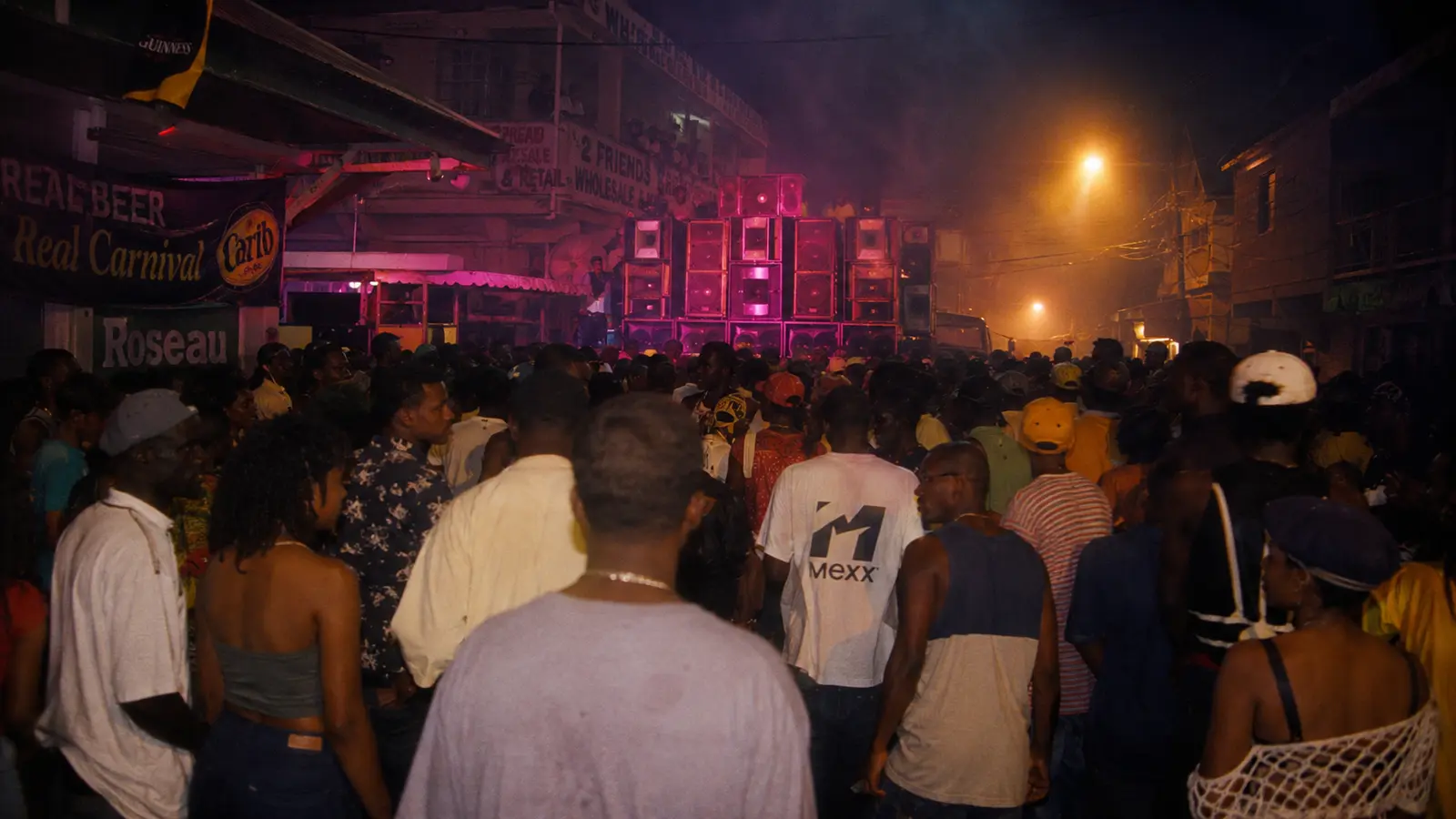
A year passes. No rupture, no manifesto. Just an observation that progressively settles in Roseau, in the neighborhood sound systems, in the carnival trucks, on the cassettes that pass from hand to hand: a Bouyon single is recognizable in two bars. The language has become recognizable to the ear. The WCK gesture has held.
The summary is synthetic. A drum machine, the TR-505, that lays down the tireless 152 BPM. A live drummer and a lapo kabwit percussionist who negotiate with the machine in the same room. Three Dominican roots, cadence-lypso for the harmonic grammar, jing ping for the rural pulse and the accordion motif, lapo kabwit for the ritual anchor and the human grain. Two Anglophone contributions. Trinidadian soca for the carnival energy, Jamaican dancehall for the riddim mechanics and the toaster phrasing. A singular voice. Skinny Banton's, arrived around 1995, who opens the bouyon-muffin branch and the raasuka sub-current. The recipe is stable. Eight years after One More Sway, WCK is no longer searching. The band plays what it found.
Distribution follows. Bouyon now circulates throughout the Caribbean through the two channels of the era: the cassettes that get duplicated from hand to hand between Roseau, Pointe-à-Pitre, Fort-de-France, Saint-Martin and the New York diaspora, and the sound systems that play the Dominican singles alongside Trinidadian soca and Jamaican dancehall in the neighborhood feasts. The market is small, the logistics are artisanal, but the distribution is real. For the first time since Gordon Henderson's cadence-lypso, Dominica exports a sound that carries its name.
It is also in 1996 that the word "Bouyon" officially settles as a genre label. WCK's first album, One More Sway (1988), did not carry the word yet. A WCK internal voice situates its public officialization precisely in 1996 [I-7]: the year it becomes a category recognized by the Caribbean press, by radio programmers, by the public. This nuance counts. It reminds us that a musical genre does not exist only because you play it, it exists when you name it, and when the name holds.
Then there is the other side of the assessment. WCK has laid down the language, but the language now demands speakers. The Roseau carnival hosts more Bouyon singles every year, but few solo artists take the individual relay. The logic stays that of the band, collective unit, choruses sung together, authority shared between voices. It is a strength for the foundation, but it is a limit for the expansion. Bouyon still has to learn to carry a single figure on stage, a name you remember, a face that circulates on the carnival sleeves and flyers. The grammar is in place. The ambassadors are still missing.
Bouyon has its language. It still lacks its ambassadors. That's the story that begins with Asa Bantan.
FAQ : the WCK grammar in questions
Why is WCK considered the founding band of Bouyon? Because between 1988 and 1996, WCK is the only band in Dominica to stabilize a grammar recognizable in two bars, three local roots (cadence-lypso, jing ping, lapo kabwit) + two Anglophone contributions (soca, dancehall) + the TR-505 drum machine. No other band of the period (RSB, First Serenade) laid down such a coherent vocabulary.
Cadence-lypso, jing ping, lapo kabwit, what's the difference? Three distinct Dominican roots. Cadence-lypso (Gordon Henderson, 70s) is the modern popular genre. ~95 BPM, fusion of calypso + kompa + jazz. Jing ping is the rural traditional music on accordion, drum, triangle and shak-shak. Lapo kabwit is the family of goatskin drums of the Creole carnival, played in groups in call-and-response. WCK puts all three in the same pot.
What is a riddim and why is it central to Bouyon? A riddim is an instrumental built once and reused for several successive voices. It's a logic inherited from Jamaican dancehall. The TR-505 makes this logic reproducible in Roseau: if the machine holds the same tempo from one title to another, you record the base once and bring three, four, five singers back over it.
Why didn't WCK switch to 100% machine programming like most of the Caribbean did? Strategic choice. Many Caribbean bands of the 80s drop their live drummers when the drum machine arrives. WCK keeps the drummer AND the lapo kabwit percussionist in the room with the TR-505. The machine gives the metronomic rigor; the humans keep the groove, the accents, the breath. That tension is what signs the Bouyon sound.
Is the Bouyon Skinny Banton the same as the Grenadian Skinny Banton? No. Two different artists with the same stage name. The Bouyon Skinny Banton is the one from Dominica, alias Shadowflow then Skinny Banton, who joins WCK around 1995. The Grenadian Skinny Banton is a soca artist from Grenada (Wrong Again 2019, Water 2023). No documented collab between the two.
Bouyon-muffin vs raasuka, what's the nuance? Bouyon-muffin is a sub-genre opened by Skinny Banton around 1995. Jamaican ragga toasting + a more moderate tempo (110-135 BPM) to let the voice breathe. Raasuka is an internal sub-current of bouyon-muffin: same tempo, but rougher vocal attack, more rhythmic, less melodic. Singing becomes a percussion instrument in its own right.
Why does 1996 close the WCK chapter? Because it's the year the word "Bouyon" officially settles as a genre label recognized by the press, radio and public. WCK's first album, One More Sway (1988), did not carry it yet. A WCK internal voice in fact situates this public officialization precisely in 1996 [I-7].
Where can I listen to WCK Bouyon today? The WCK 1988-1996 repertoire circulates in fragments on YouTube via DBS Radio archives and Soca Records reissues. To hear the WCK grammar reinterpreted by the current generation, listen to the New Bouyon Wave (TIITII NBA, 1T1, Softee, Aknose, Nils, Theomaa, Le Juh, Lucky lukee), we cover them in chapter VII.
To go further
- Before bouyon. Chapter I, already read? skip, or reread for context before 1988. - The battle of the bands. Chapter III. Triple Kay and the Roseau Carnival (1996-2010). - Bouyon reaches Guadeloupe. Chapter IV, how Bouyon reaches Guadeloupe through Vador, DJ Joe and Yellow Gaza (2007-2013). - The New Bouyon Wave. Chapter VII, the contemporary wave: TIITII NBA, 1T1, DJ Softee, Aknose, Nils, Theomaa, Le Juh and Lucky lukee. - Listening playlist (in the works), the WCK 1988-1996 singles cited in this chapter will be gathered into a dedicated YouTube/Spotify playlist. Come back soon. - Back to the Bouyon hub, the complete map of the 12-chapter series.
