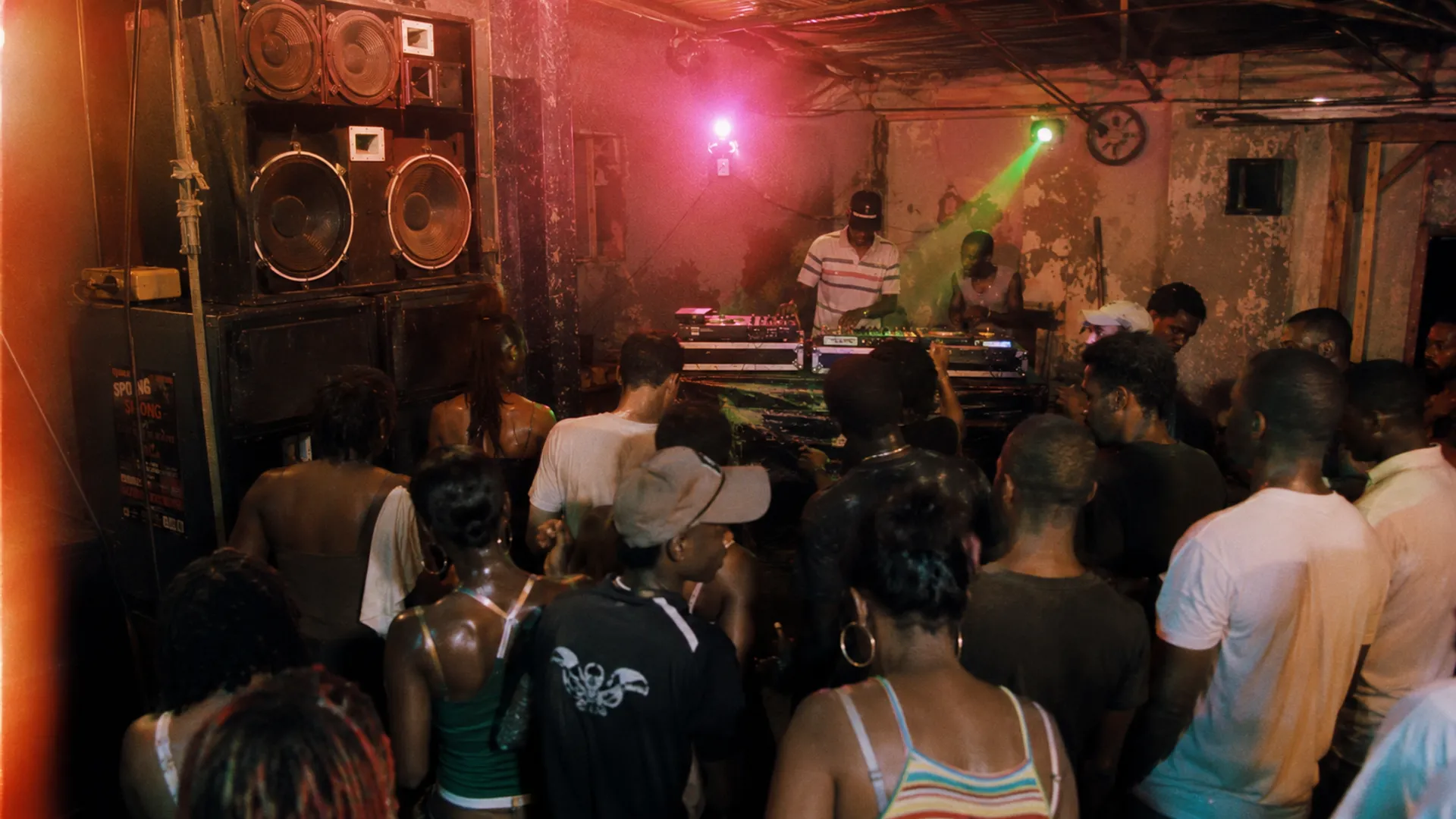


In short. Between 2007 and 2013, Bouyon crosses from Dominica to Guadeloupe. Vador, Aknose's cousin, organizes the first dedicated nights at Krazy Tras with Francky Belote. In 2009, the genre is officially banned in Guadeloupe ("blackout, it's too trash"), but Gaza Girls Crew, Yellow Gaza, J2MO and Suppa structure the first underground wave. In 2013, Suppa is killed in Guadeloupe, the first wave dies with him.
Before 2007: Guadeloupe is already listening
Before 2007, Guadeloupe is not musically blank toward Dominica. Guadeloupean sound systems have long broadcast cadence-lypso, Jamaican dancehall, Trinidadian soca, Antillean zouk. The diaspora circulates between Pointe-à-Pitre, Roseau, Brooklyn, Toronto, Paris, and with it, cassettes, MDs, MP3s, records. Radios pick up beyond island borders. The Dominican Bouyon of WCK and Triple Kay (chapters II and III) reaches Guadeloupean ears through a thousand informal channels long before becoming a public scene on the island.
If you were born in Guadeloupe or scroll TikTok there, you've probably heard that "Bouyon Gwada was born in 2023 with the New Bouyon Wave." That's wrong, and this chapter explains why. You'll discover Vador, Aknose's cousin who imported Bouyon from Dominica as early as 2007, the official "blackout" of 2009, Gaza Girls Crew (the first female Bouyon collective), Yellow Gaza, J2MO and Suppa, the first wave that paved the road before TIITII NBA and 1T1 picked up the mic.
A nuance must therefore be held at the start of this chapter: the first Bouyon Gwada wave does not create Bouyon listening in Guadeloupe, it creates the local infrastructure that lets Bouyon be played from Guadeloupe, rather than just listened to from Dominica. The distinction is between passive consumption (Guadeloupeans listen to Triple Kay on cassette) and active production (Guadeloupeans make Bouyon themselves, with their own voices, their own venues, their own creole).
That move from consumption to production demands material conditions. You need dedicated nights, not just a few Bouyon singles slipped into a zouk set. You need sound systems willing to play it. You need organizers willing to risk programming a still publicly-unrecognized genre. You need artists willing to sing in creole over Bouyon riddims. You need a public large enough for a night to hold. And, on the surface, you need enough institutional legitimacy that the police don't shut everything down.
By the late 2000s, those conditions are not yet coordinated. Several Guadeloupean DJs slip Dominican Bouyon into their sets, several young artists try a verse in creole over a WCK riddim, several venues accept a mixed zouk/Bouyon night occasionally. But there is no structuring organizational figure yet that turns this diffuse ecosystem into a named scene. Bouyon Gwada has no public passeur yet.
That passeur arrives in 2007. The public knows him as Vador (sometimes spelled Vadore). And the crossing begins.
2007: Vador opens the door
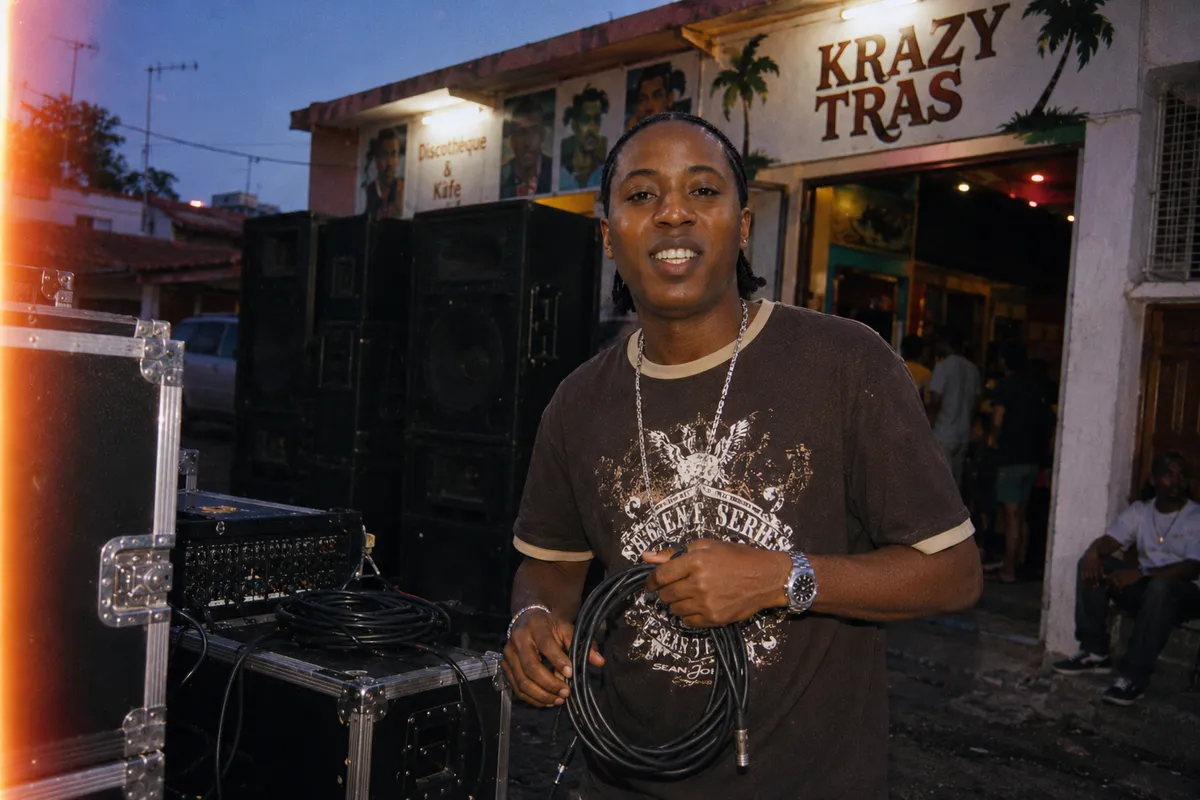
Vador appears in 2007 as the first structuring organizational figure of Bouyon in Guadeloupe. According to the daily Le Courrier de Guadeloupe, he organizes Bouyon nights with his uncle starting that year and quickly partners with Francky Belote, owner of Krazy Tras, a venue identified in local press as one of the first physical nodes of Bouyon Gwada. That association, an organizer (Vador) + a venue owner (Belote) + a building public, establishes the material conditions of the first wave.
The detail rarely made explicit in the press comes later, through an oral source. In his interview at Loxymore at Karukera One Love Festival (2 April 2024), Aknose confirms that Vador is his cousin [I-15]. That family connection is not anecdotal. It tells how the first Bouyon Gwada wave is built, not by a cultural institution or industrial label, but by intimate circles (family, friends, Krazy Tras circuits) that gradually rise into public visibility. Transmission is intimate before institutional. That is also what explains its fragility, when the intimate fabric tears, as with Suppa's death in 2013, the entire scene wavers.
The Vador 2007-2013 dispositif articulates several functions that did not exist before in Guadeloupe: - Dedicated Bouyon night organization, with regularity that builds an accustomed audience. - Network hub between Dominica and Guadeloupe: Vador connects Dominican artists who want to play in Guadeloupe (Suppa is the major example) with local venues that accept programming them. - Local label under the Vadore Concept Groupe brand from 2011-2012, releasing singles and structuring Bouyon Gwada production. - Live tour: the Bouyon Music Live Tour 2012, organized by Vador, institutionalizes the Bouyon Gwada scene in the middle of the hostile institutional climate (see 2009 blackout in section III).
Beside Vador, two other figures complete the import dispositif. DJ Joe is a Guadeloupean Bouyon DJ active at least 2012-2013 and still associated with Vadore Concept events through 2022. Oral genealogy (Aknose interview [I-15]) ties Vador and DJ Joe as the two Guadeloupeans who imported Bouyon from Dominica. Aknose's direct phrasing. That double figure tells us the crossing is not the work of one man alone; it requires at least an organizer (who thinks the night and the venue) and a DJ (who plays the singles and holds the energy).
The third element is the Yellow Gaza project, which the same interview [I-15] describes as "the pioneer project that planted the seed in Guadeloupe". Yellow Gaza is not a classic artist-band, it is a collective/bridge that aggregates voices, producers and nights under an umbrella brand. Its first public catalogue trace dates to 1 May 2012 (Bouwe'y feat Tasmo & Keytzone, Apple Music), but Booska-P explicitly places the project in the public Bouyon Gwada chronology as early as 2010.
By this point, late 2007, early 2008. Vador has opened the door. But an open door is not enough if someone closes it.
2009: the blackout
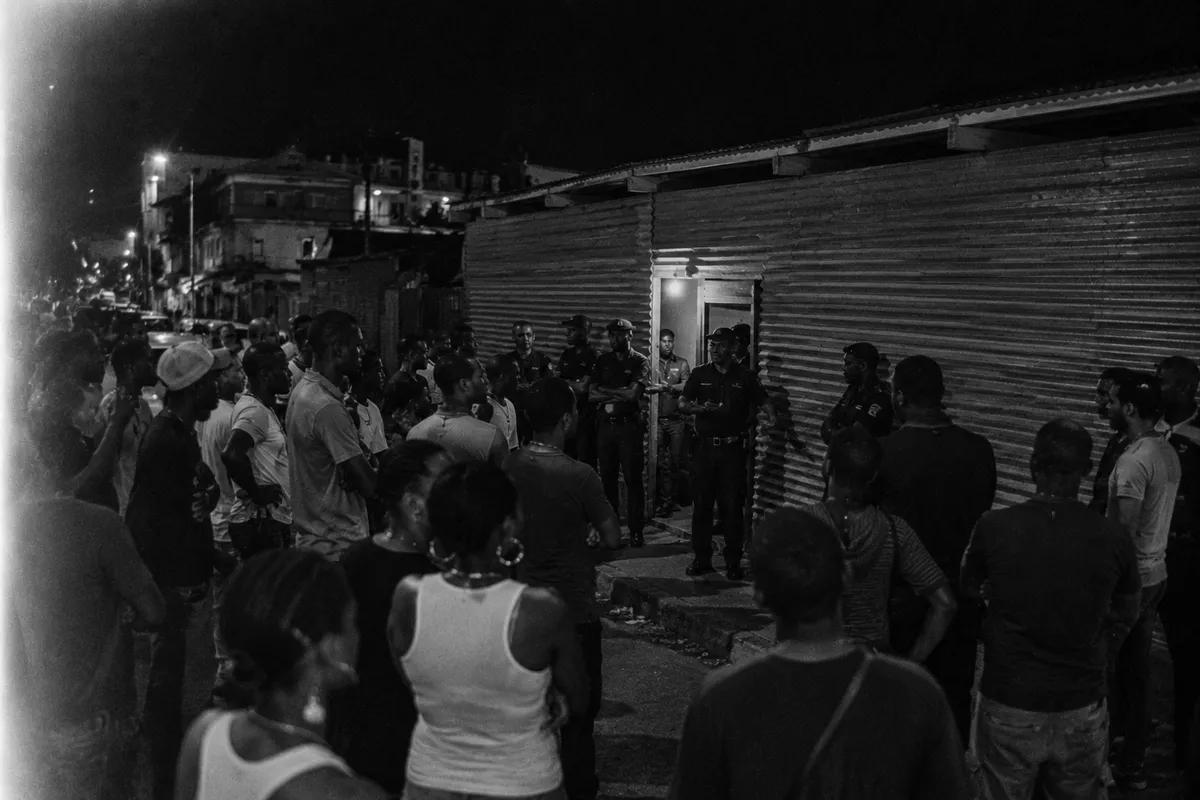
In 2009, two years after Vador's organizational arrival, Bouyon is officially banned in Guadeloupe.
The most direct public trace comes from an Aknose interview post-Skyrock at France-Antilles in the Karukera Festival context. Aknose reports the authorities' phrasing as it has circulated in scene memory: "They said blackout, it's too trash" [I-16]. That phrase, preserved in first-wave memory, captures the nature of the institutional conflict: authorities judge the Bouyon aesthetic too crude, too sexualized, too dancehall for the wider Guadeloupean public, and choose to remove it from official public programming.
The climate is independently confirmed three years later. Dominica News Online, in a 2012 article titled "Guadeloupe clamps down on Bouyon Gwada", documents the persistence of the institutional conflict. Guadeloupe maintains a surveillance and restriction frame on Bouyon nights. It is not a passing measure that disappears after a few months. It is a durable climate that structures the entire first wave duration.
For artists and organizers, the blackout has two contradictory effects. First effect: the scene retreats partly into the underground. Bouyon Gwada nights exist, but they are less publicly exposed, more dependent on intimate networks (cousinships, friends, Krazy Tras circuits), rarer in local media. Second effect: the scene strengthens its identity through opposition. When a genre is officially rejected, the public that identifies with it bonds more strongly. Bouyon Gwada is not just a music, it becomes, across the 2009-2019 decade, a cultural assertion against a hostile institutional frame.
That ambiguity is itself political. An openly assumed censorship would have forced authorities to formulate a precise critique of Bouyon as a genre, which would have opened a public debate on cultural expression. A non-specific generic regulation avoids that debate while obtaining the practical effect of censorship: fewer Bouyon nights, less enthusiastic local press, less visibility in public programming. That gray zone is precisely what makes the 2009 ban hard to analyze cleanly.
But despite the blackout, the scene does not disappear. It continues in shadow, and between 2010 and 2012, it leaves public discographic traces that allow precise mapping today.
2010-2012: Gaza Girls, Yellow Gaza, J2MO
Despite the institutional blackout of 2009, the first wave finds its public discographic trace between 2010 and 2012. That trace is what allows us today to prove, beyond oral memories, that there indeed was a Bouyon Gwada before the New Bouyon Wave.
The turning point cited by Le Courrier de Guadeloupe is the creation of the Gaza Girls in 2010. It is the first documented female Bouyon collective in Guadeloupe, and that matters. 2000s Dominican Bouyon (chapter III) is overwhelmingly male: Triple Kay, its rival bands, the emerging solo Asa Bantan, all male. Gaza Girls Crew brings to Guadeloupe a dimension absent from Dominica at the time: a female collective that claims a place in Bouyon. That difference is not anecdotal, it tells how the first Gwada wave is not a copy-paste of Dominica, but a graft that takes a new form.
On 1 May 2011, Apple Music documents the release of `Sa Zot Vle` (Gaza Girls Crew) on the Bouyon Concept label. It is the Crew's first solid catalogue marker. The single also feeds the Shazam trace, which confirms its lasting presence in public listening, not just in underground nights, but also in mainstream digital memory.
In parallel, Yellow Gaza confirms its public trace. Apple Music dates `Bouwe'y` (Yellow Gaza feat Tasmo & Keytzone) to 1 May 2012. Booska-P explicitly places Yellow Gaza and Gaza Girls Crew in the public Bouyon Gwada chronology as early as 2010. The project is not the emanation of a single artist: it is an umbrella brand under which several configurations release singles, which matches Vador's organizational logic (a dispositif that puts artists to work rather than a single star group).
On the technical front, J2MO / J2mothebeatcooker emerges as a pioneer beatmaker. His Bandcamp and Apple Music archive documents an activity that ties him to Suppa, Gaza Girls, Asa Bantan and Miky Ding La. Booska-P distinguishes J2mothebeatcooker and J2modj inside the J2MO duo, which reminds us that a single artist name can cover several people, a frequent detail in early waves poorly documented by classical institutions. What is solidly identifiable is the function: J2MO makes riddims, productions, instrumentals on which others come to topline. Without that technical infrastructure, Yellow Gaza and Gaza Girls voices would have had nothing to land on.
Beside J2MO, several other figures active in 2012 complete the first wave: - DJ Joe, the DJ of the Vadore Concept circle. WCK records dubplates for him as early as March 2011, and he is on the bill of the Bouyon Music Live Tour in May 2012. His trace does not stop in 2013: in April 2014, his Bouyon Remix Mix appears on Vadore Concept's The Bouyon Remix mixtape, and on 5 February 2023, Bwé Rhum with Asa Bantan comes out in the label's Bouyon Kings Mixtape series. - Weelow / Wee Low, releases in 2012 Ni Sa La and Frappéy on Bouyon King / Label Bouyon Music. The SoundCloud trace dated 2012-02-11 (WeeLow - pompey (bouyon) on Co3 Studio) confirms Weelow's activity in early Bouyon Gwada riddims. He does not stop in 2013 either: he comes back in chapter V. - Doc J, one of the voices of the Vador setup. On 31 December 2011, A Pa Taw with Kassidjé comes out on the Vadore Concept Groupe YouTube channel. Then come Mytho with Weelow and Ti Chô (March 2012, JDMO production), Nou Ka Fly with Kassidjé and the Gaza Crew (September 2012), then Mander Mal Baw (February 2013), credited "JDMO / Vador Concept". His trace does not stop with the first wave: he comes back in chapter V. - Miky Ding La. He presents himself as a dancehall artist, but he is on bouyon from summer 2012: Batte gèl ar in July, then Bitin woz, on a J2MO composition, which circulates in late August tagged "Bouyon 2012" (Apple dates it 1 March 2013). He never leaves the genre: Koké La (Bouyon Kings) with Yellow Gaza on Vadore Concept Groupe in January 2022, Sa Dou with 1T1 and Shanika in 2023, Nympho with HB War in 2024. Bridge between first wave and new Gwada generation. - Arendi, from Gourbeyre. He also makes dancehall, but he files Pété Tête Aw as bouyon on his own SoundCloud as early as July 2012, and Tout est Permis comes out in February 2013 with "Bouyon" in the title. His bouyon line does not break: chapter V follows it. - Mr Gwada, a Dominican voice. According to his own biography, he leaves Dominica in 2000 to join his father in Guadeloupe, and the island gives him his stage name: the video for GWADA (Everybody wan Go), produced by DJ Flip, goes online on 5 January 2013. He does not stop there: the album Bouyon comes out in 2020, LEGEND (Bouyon Blacksheep) in October 2025, and he opens 2026 with Deja Koke', where he invites Kassidjé.
The synthesis public event of the period is the Bouyon Music Live Tour 2012, organized by Vadore. It marks the institutionalization of the Bouyon Gwada scene despite the hostile institutional climate, a way of saying publicly "we are here, despite everything."
Suppa: the Dominica-Guadeloupe arc
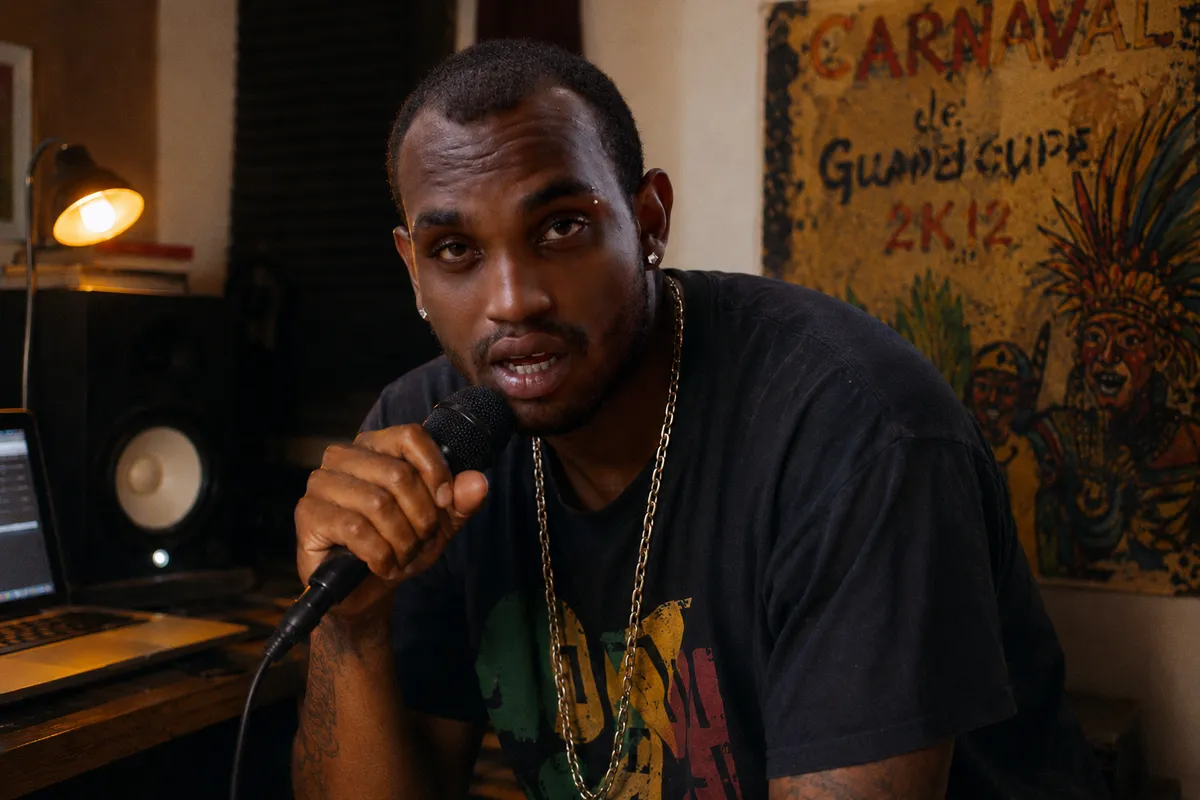
At the heart of the first wave, one figure links Dominica and Guadeloupe: Suppa. A Dominican Bouyon artist installed in Guadeloupe, founder of the Gaza Crew, he documents his passage through several SoundCloud traces dated 2011-2013 (Suppa - I Don't Know on Vadore Concept Groupe, 16 November 2011; Tchek via Suppa Gaza Crew).
Suppa is not Guadeloupean. He is Dominican. His presence in Guadeloupe between 2011 and 2013, and his structuring role inside the Gaza Crew alongside Vador, physically embodies the crossing this chapter tells. It is not a genre that allows itself to immigrate; it is a Dominican artist who accepts to live, produce, share a scene in Guadeloupe.
That physical Dominican presence in Guadeloupe has an effect on public perception of Bouyon Gwada. When a Guadeloupean sees Suppa on stage with Vador and the Gaza Crew, he sees confirmation that Bouyon Gwada is not a simple imitation of Dominican Bouyon, it is a scene where Dominicans and Guadeloupeans work together. Bouyon Gwada is a mixed genre by construction, not a national genre.
The graft figure is useful for understanding the rest of the story. A graft demands two things: a rootstock (the terrain that receives) and a scion (the imported element). The Guadeloupe rootstock (its Caribbean diaspora, its sound system culture, its zouk-dancehall scene) is solid for a long time. The Bouyon scion arrives in 2007 through Vador, is consolidated by Suppa between 2011 and 2013, and finds its bloom with Gaza Girls, Yellow Gaza, J2MO. But a graft is also fragile: if the scion dies, the graft may not hold.
That is what happens in 2013.
2013: the crossing has a cost
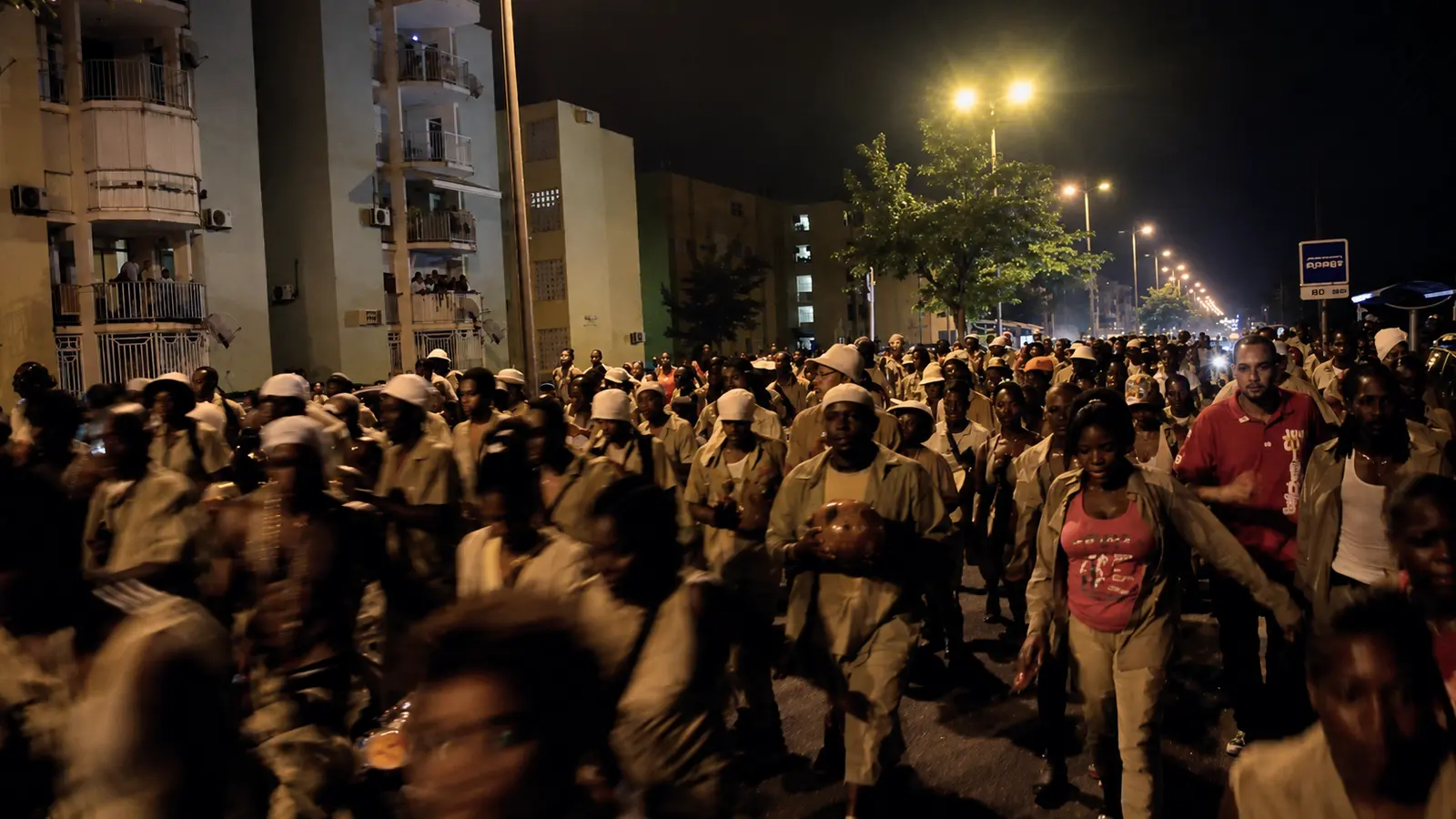
In 2013, Suppa is killed in Guadeloupe. Dominica News Online documents the event in an article titled "Dominican Bouyon artiste killed in Guadeloupe". His death marks the end of the Dominican pivot installed in Guadeloupe.
With Suppa, the first wave loses its Dominican pivot installed in Guadeloupe. Vador keeps organizing, Yellow Gaza and Gaza Girls maintain occasional releases through 2014, but the first-wave dynamic gradually runs out. Between 2014 and 2016, Bouyon Gwada disappears from public visibility, not permanently, as the next chapter will show, but enough that the scene must reinvent itself.
That three-year eclipse is no minor detail. It marks the moment when the Bouyon Gwada graft planted in 2007 loses enough sap that it must be partly replanted. The 2016-2022 Gwada transition. DJ Weez, Bilix, Kevni, Lunik / Ludmael Flower, Edday, Lestef KJF, FLW, Team Bwe Tou Sa, will be treated frontally in chapter V. And the new wave, the New Bouyon Wave 2023-2026 (TIITII NBA, 1T1, Aknose, the MJC des Abymes network), will take the relay as conscious heir of this first wave. Aknose, in his 2024-2026 interviews, regularly recalls that the New Bouyon Wave does not begin in 2023, it inherits a memory that begins in 2007 with his cousin Vador.
The first wave has passed. Guadeloupe has tasted Bouyon. But before it picks up the mic with a new voice, it will need three years of silence.
FAQ : the first Bouyon Gwada wave in questions
Did Bouyon Gwada start in 2023 with the New Bouyon Wave? No. The first wave goes back to 2007, carried by Vador who organizes the first dedicated Bouyon nights in Guadeloupe with his uncle and Francky Belote at Krazy Tras. Gaza Girls Crew (2010), Yellow Gaza (2010), J2MO and Suppa structure the 2010-2013 scene before Suppa's death in 2013 puts the first wave on hold.
Who is Vador, and what's his exact role? Vador, sometimes spelled Vadore, is Aknose's cousin (revealed in his Sweet Times With Daryna interview, January 2026 [I-15]). He is the first structuring organizational figure of Bouyon in Guadeloupe from 2007, he organizes nights, sets up the Vadore Concept Groupe label in 2011-2012, programs the Bouyon Music Live Tour 2012, and bridges Dominican artists (Suppa) with local venues.
What is the 2009 "blackout"? The official ban of Bouyon in Guadeloupe by local authorities. Phrasing reported by Aknose in a France-Antilles interview: "They said blackout, it's too trash" [I-16]. Dominica News Online documents the persistence of the hostile institutional climate in a 2012 article. The scene continues underground throughout the period.
Who are the Gaza Girls Crew? The first documented female Bouyon collective in Guadeloupe, formed in 2010. First Apple Music catalogue release: `Sa Zot Vle` on the Bouyon Concept label (1 May 2011). It's a dimension absent from Dominica at the time, where Bouyon is overwhelmingly male (Triple Kay, its rival bands, Asa Bantan).
Are Suppa and Skinny Banton the same artist? No. Two different Dominican artists. Suppa is the founder of the Gaza Crew, based in Guadeloupe between 2011 and 2013, killed in Guadeloupe in 2013. Skinny Banton is the singer who joins WCK around 1995 and opens bouyon-muffin (chapter II). Not the same person, not the same era, not the same role.
Yellow Gaza, Gaza Girls, Gaza Crew, are these linked? Three distinct entities, but networked. Gaza Girls Crew: female collective, first release 2011. Yellow Gaza: historical bridge collective 2010-2014, umbrella brand under which several configurations release singles. Gaza Crew: crew founded by Suppa, more single + features oriented. All three orbit the Vador ecosystem and cross features between 2010 and 2013.
Why does the first Gwada wave die in 2013? Because Suppa, Dominican pivot installed in Guadeloupe and backbone of the Gaza Crew, is killed in 2013. Vador keeps organizing, Yellow Gaza and Gaza Girls maintain occasional releases through 2014, but the dynamic runs out. Between 2014 and 2016, Bouyon Gwada disappears from public visibility, the 2016-2022 transition (chapter V) is what prepares the 2023-2026 New Bouyon Wave explosion.
What's the link between this first wave and the New Bouyon Wave today? Aknose, in his 2024-2026 interviews, recalls that the New Bouyon Wave consciously inherits this first wave. Vador is his cousin, and the entire 2007-2013 memory is claimed. TIITII NBA, 1T1, Aknose, the MJC des Abymes network do not start from zero in 2023, they take the relay of a scene that had already been built, banned and gone silent.
