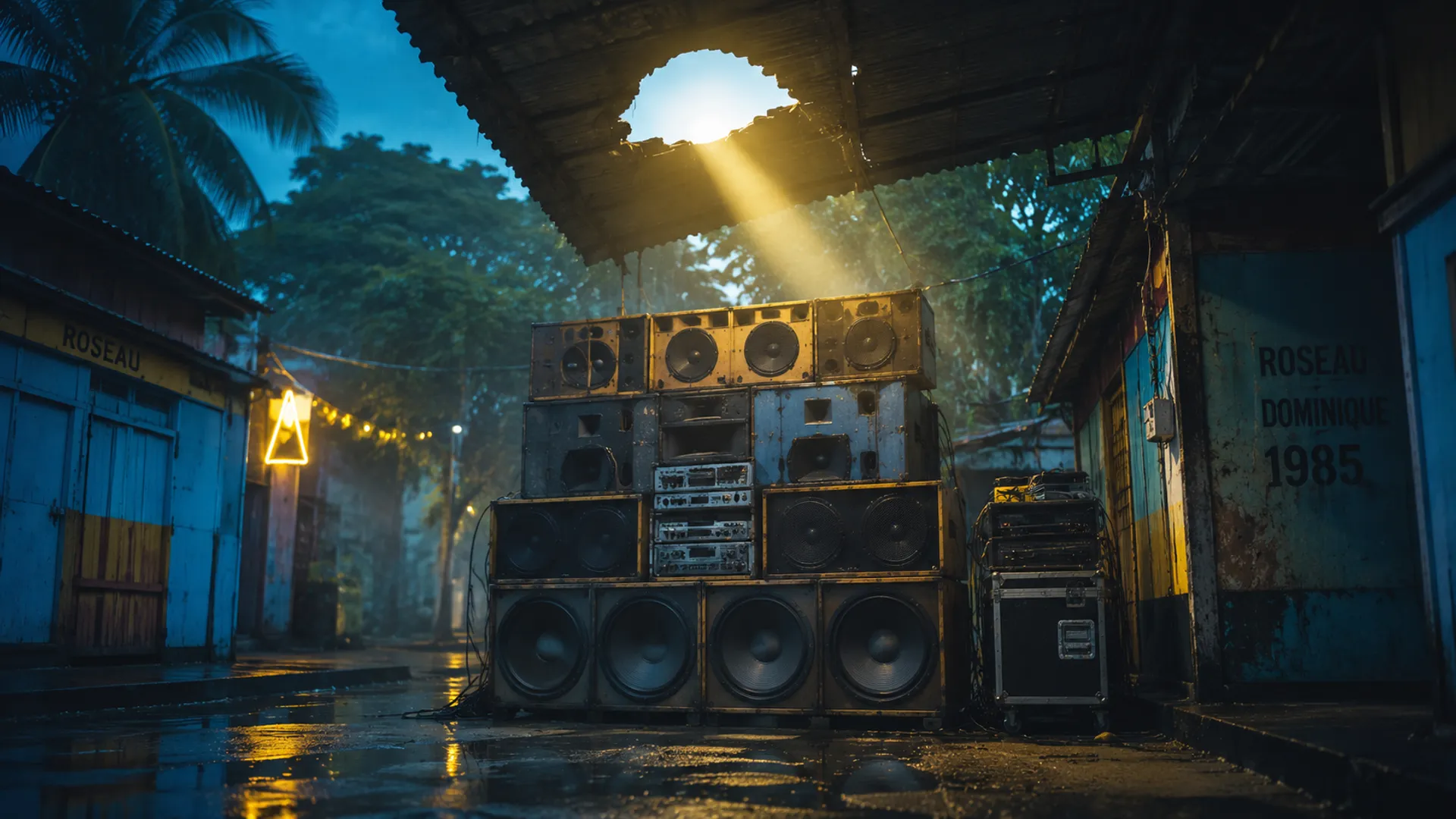


In short. Bouyon was born in Dominica in 1988, when the band WCK recorded One More Sway in Roseau. But the genre did not come out of nowhere: it is the result of ten years of fermentation between cadence-lypso (95 BPM), Roseau sound systems, and the arrival of the Roland TR-505 drum machine in 1986.
Dominica, 1986. A drum machine enters Roseau. Nobody, at that moment, suspects that this small device is about to change the music of an entire island.
You just discovered Bouyon on TikTok or at a party, and you want to know where it really comes from. You are in the right place: this article goes back to the exact roots of the genre, not the legend. We are going to see how three precise ingredients (cadence-lypso, the sound system, and the drum machine) prepared the ground where the 1988 seed could germinate.
The drum machine lays down its tempo on soil already prepared for ten years by cadence, the neighborhood sound systems, and the carnival bands. Bouyon doesn't arise from nothing, it arises from accumulation. To understand what happens in 1988 when WCK records the album One More Sway in Roseau, we first need to understand what happens in the 1970s and 1980s: how Dominica builds, without naming it, the ground where a genre is about to germinate.
Cadence-lypso, the first signal
In the 1970s, Dominica already has a musical signature. It is called cadence-lypso. Gordon Henderson and his group Exile One are its architects. Cadence-lypso fuses calypso, Haitian kompa, and jazz influences, a dense, danceable Caribbean blend that circulates throughout the archipelago. The cadence-lypso tempo sits around 95 BPM.
That number matters. Because Bouyon doesn't reinvent the rhythm, it doubles it. The move from 95 to 152 BPM is the carnival acceleration, the pressure of the crowd, the drum machine that never tires. Gordon Henderson is not a Bouyon artist. But his cadence is the matrix. Without it, no fertile soil.
In 1987, Exile One records L'hivernage, a track sung mas and lapo kabwit that French Antillean audiences call "jump up", a carnival pulse that directly prefigures Bouyon. This is not yet the genre. It is the imprint before the genre. The outline in the earth before the seed falls.
Cadence-lypso also transmits something musicologists don't always note: a culture of the collective. You don't play cadence alone. You play it in a band, in front of people dancing, in specific places, at specific moments. This logic of gathering is the founding logic of Bouyon, and it is inherited, not invented.
What Gordon Henderson's generation builds in the 1970s is a listening public trained to hear the Caribbean in its music. Dominica's dancers know calypso. They know kompa. They recognize the groove of their own island. When Bouyon arrives, it doesn't need to teach anyone anything, it speaks a language already familiar, just at a speed the body has been waiting for.
Before Bouyon, there is the cadence. Without Gordon, none of us.
→ But before the tempo, there is the place
The sound system is not a device. It is a place. And that place decides which music rises, and which disappears.
The sound system before electronics
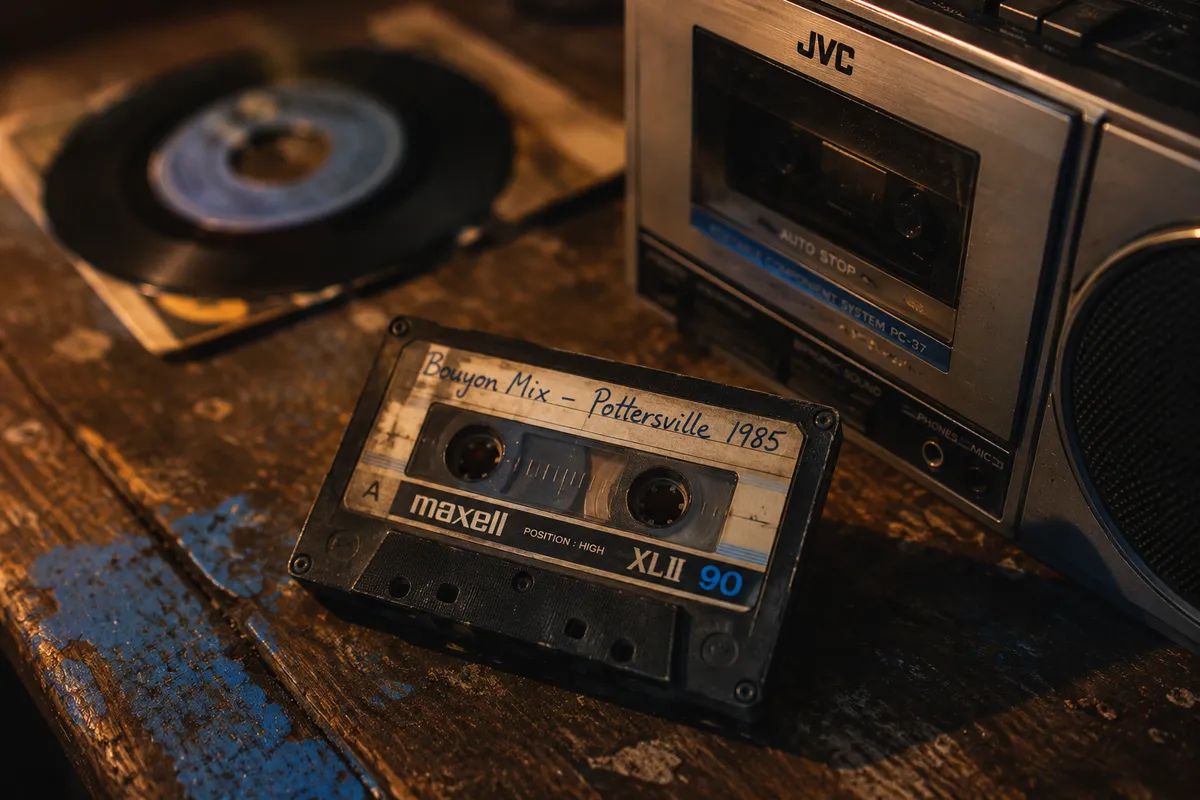
The sound system, in Roseau during the 1980s, is not a device. It is a place. A gathering point where a community comes together, where people carry speakers and amplifiers into the street, where a selecter decides what is heard. In Pottersville, in Goodwill, in Fond Cole. Roseau's neighborhoods each have their own sound, their own crowd, their own tradition.
The selecter is the central figure of this universe. He decides the tempo, raising and lowering it according to the energy of the crowd. This logic of the selecter, adapting sound to the moment, reading the room, accelerating when needed, is a logic that Bouyon absorbs and codes into its very structure. The modern Bouyon DJ inherits this instinct directly. He does not invent it; he formalizes it.
Bouyon pushes the tempo of cadence-lypso up by about 60%. ~95 BPM → ~152 BPM. Three years are enough to shift from a storytelling tempo to a driving tempo.
Roseau's sound systems in the 1980s broadcast two types of sound: Jamaican reggae and local cadence-lypso. These two worlds coexist in the same streets. Reggae brings the culture of the riddim, an instrumental that loops, over which multiple voices can intervene. Cadence brings the Caribbean anchor, the Creole tempo, the language. Between the two, DBS Radio broadcasts local productions and tracks from the French Antilles.
This coexistence is not incidental. It explains why Bouyon, when it emerges, is already multi-genre: it does not invent hybridization, it perfects a hybridization already underway in Roseau's neighborhoods for ten years. The sound system is a school without a curriculum. You learn there to feel what moves people, and that knowledge does not transmit in writing.
Local groups. First Serenade in Pointe Michel, RSB (Roots, Stems and Branches) with tracks like Break Loose and Kadanse, evolve in this space. They are not Bouyon in the strict sense. They are the transition: musicians working with the tools of cadence and sewo while searching for something faster, more direct, more carnivalesque. They are the bridge between what existed and what is coming.
The sound system also establishes a performance economy: music is not a studio product delivered to passive listeners. It is a live test run before a crowd that votes with its body. What moves people survives. What doesn't disappears by the next weekend. This merciless filter is what Bouyon is forged in, before it even has a name.
→ And 1986 accelerates everything
A Roland drum machine enters Roseau. Nobody knows exactly how. Three years later, no one plays without one.
The drum machine arrives in Roseau
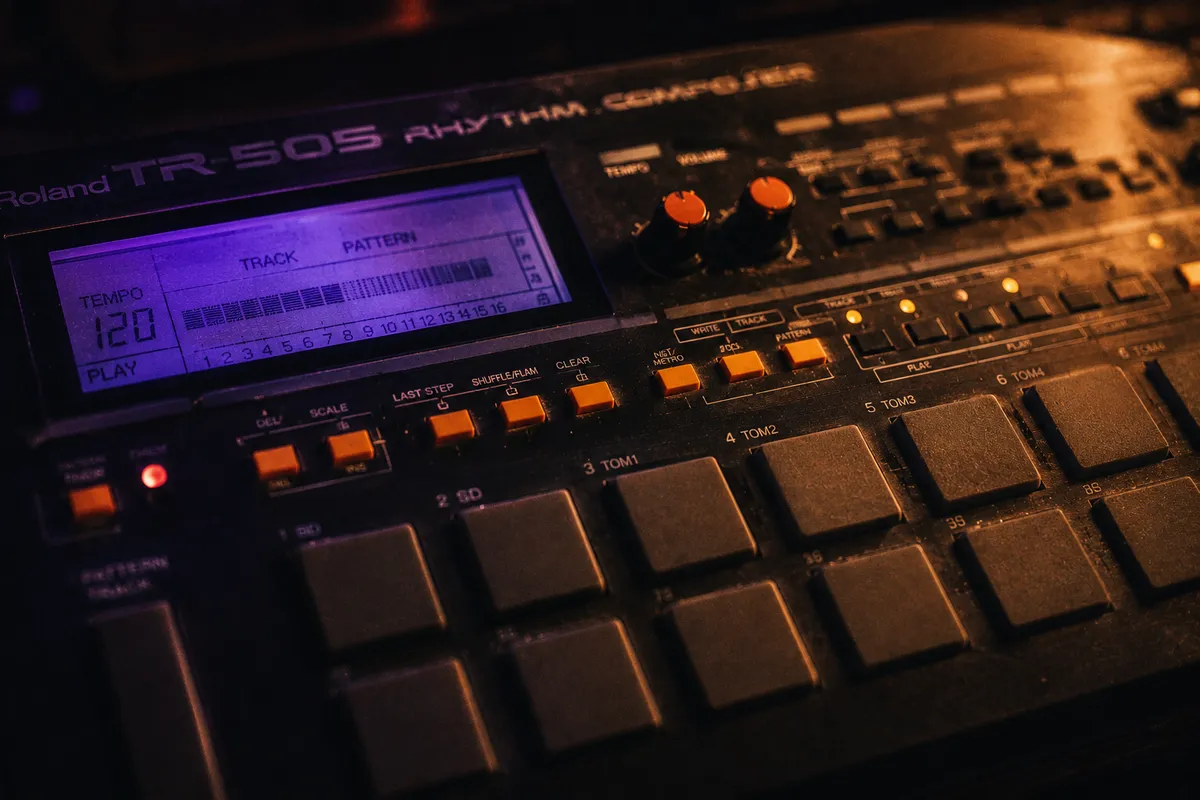
The Roland TR-505 is not the first drum machine to exist, but it arrives in Roseau at the right moment. In Jamaican and New York studios, Roland rhythm machines have existed since the early 1980s. By the time they reach the Lesser Antilles, Dominican musicians have had time to hear, on cassettes circulating through diaspora networks, what these machines do to sound. They know what they are looking for.
The TR-505 solves a concrete problem: carnival bands need a constant tempo, a pulse that does not tire, that does not rush under the heat, that holds the procession's rhythm for hours. A human drummer, however skilled, is not the TR-505. The machine is tireless. It plays at 152 BPM for as long as asked.
That tempo. 152 BPM, is not chosen at random. It is a jump of about 60% over cadence-lypso at 95 BPM. Bouyon accelerates what already existed. It does not create a new rhythm: it takes a familiar rhythm and pushes it to a carnivalesque speed, to the threshold where the body simply cannot stay still.
Seven minutes of tireless looping. A human drummer cannot hold it. The TR-505 can. This is the technical condition of Bouyon.
With the TR-505 in the circuit, Roseau's musicians make a discovery: if you remove the human bass line and let the machine run, you hear spaces. Gaps. Moments between the snare hits where something happens. Those spaces are where Bouyon is going to live. Not in the notes played, in the silences built around them.
Three years after the TR-505 arrives, every active group in Roseau integrates a drum machine into their setup. The instrument changes the music of the island faster than any trend, because it changes the physical constraint: you no longer need a drummer to play Bouyon. You need a keyboard, a machine, and a voice.
This shift also changes who can make music. Before the drum machine, a carnival band requires coordination among multiple bodies, drummer, bassist, horn section, vocalist. After: a producer, a machine, and a microphone. The barrier to entry drops. The number of groups multiplies. Roseau becomes a laboratory with more experiments running simultaneously than ever before.
WCK forms in Grand Bay
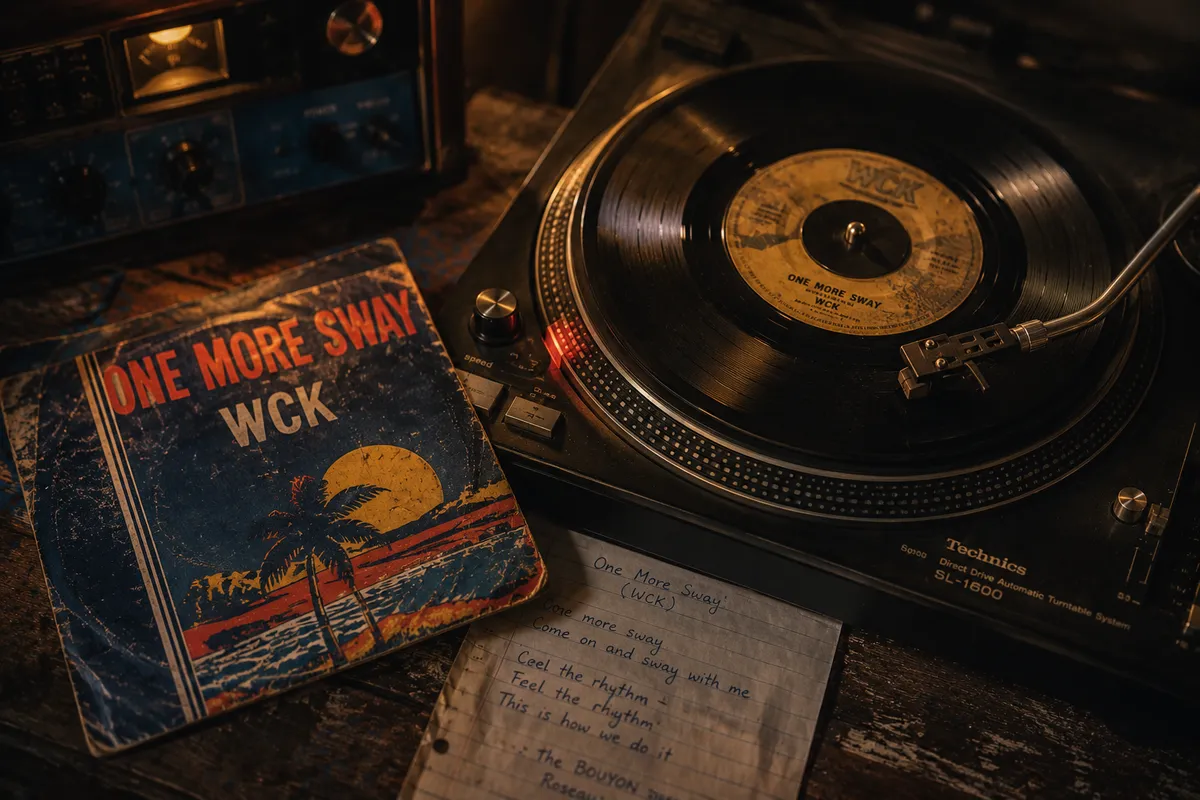
In 1988, in Roseau, south of Dominica, a group forms. It calls itself WCK. Windward Caribbean Kulture. Derek "Rah" Peters, co-founder and composer, is one of the architects of what becomes both the name and the concept of the genre. Cornell "Fingers" Phillip handles keyboard arrangements and musical direction. Mr Delly, who joins WCK in the mid-2000s, is today one of the voices telling those beginnings.
WCK is not an ordinary group in the Caribbean sense. It is a laboratory. They do not only play before an audience, they search for a form. They take cadence-lypso, jing ping (traditional Dominican accordion music), lapo kabwit (ceremonial percussion), soca, and Jamaican dancehall, and put them together in the same pot with the TR-505. The result has no name yet, but it exists.
What WCK does in 1988 with One More Sway is plant a marker. The album does not explode commercially at first, but it says something nobody had said before in that precise combination. It says Dominica has its own genre. Not a derivative of Jamaican dancehall, not a diluted version of Trinidadian soca, something that comes from Dominica, from the streets of Roseau, from Roseau's sound systems, from the TR-505 running since 1986.
The choice of the name WCK is itself a declaration. Windward Caribbean Kulture: the windward islands, Caribbean culture, the spelling with a K marking the break with academic conventions. This group does not want institutional validation, it wants to be recognized by the people who dance.
In WCK's early rehearsals in Roseau, several tensions already appear that will run through the entire history of Bouyon. The tension between pure instrumental (the machine) and voice (the singer). The tension between tradition (jing ping, lapo kabwit) and modernity (TR-505, soca). The tension between dance (fast tempo, body in motion) and narrative (lyrics in Dominican Creole, neighborhood stories).
These tensions never fully resolve. They are the engine of the genre. Bouyon moves forward because it does not choose between its contradictions, it plays all of them simultaneously. That refusal to choose is not a compromise: it is a structural decision. Bouyon is by nature a music of the threshold, between what came before and what has not yet been named.
→ 1988, the year everything shifts
And where Mr Delly and Derek « Rah » Peters tell two different versions of the same name.
1988, the zero year
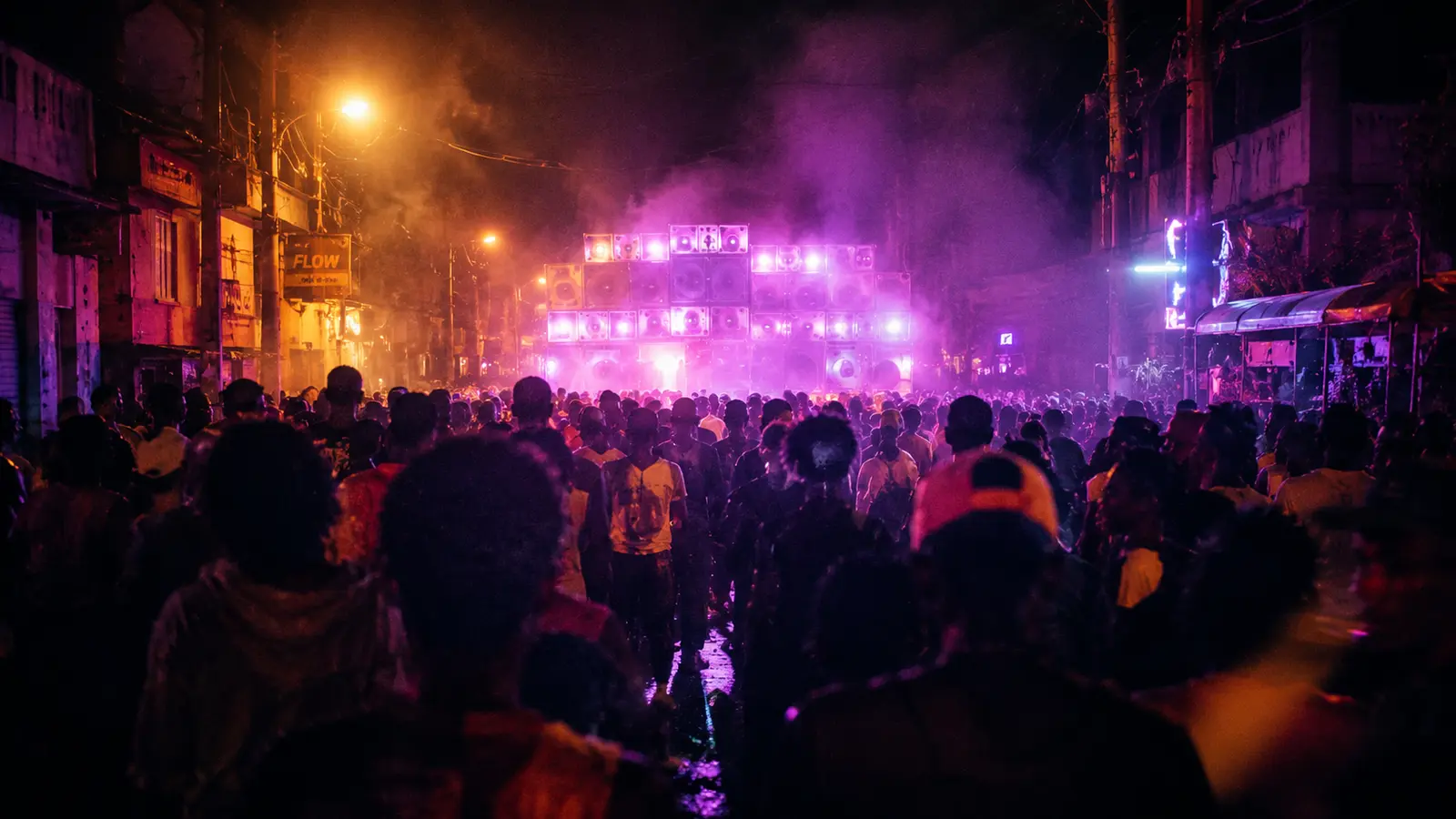
In 1988, several lines converge in Dominica. The TR-505 has been in the circuit for two years. Roseau's sound systems have educated a generation of dancers to fast tempo and constant riddim. Cadence-lypso has laid the harmonic foundations and the Creole attachment. WCK forms in Roseau with a sonic vocabulary that absorbs all of it.
This is not a revolution arriving from nowhere. It is a convergence. 1988 is not the year someone decides to invent a genre, it is the year all conditions are in place for a genre to emerge naturally.
The zero year of Bouyon. WCK records the album One More Sway in Roseau. The island immediately recognizes its own sound.
Dominica's carnival plays a central role in this emergence. Carnival is not only a celebration, it is the island's largest musical laboratory. Groups test their sounds there under real conditions, before a crowd that either dances or doesn't. Trucks loaded with sound systems move through Roseau at 3am, and what the crowd picks up at that moment is what survives. What the crowd doesn't pick up stays in rehearsal rooms.
WCK passes this carnival test. Their sound moves people. Not because it is new, because it is right. It captures something Dominican dancers had been waiting for without articulating it: a tempo fast enough for carnival, melodies close enough to cadence to be recognized, lyrics in Creole direct enough to be understood, and a collective energy strong enough to hold a whole night.
1988 is the zero year not because Bouyon was absent before, but because it is the first time all the pieces are in the same place at the same moment. Roseau. WCK. The TR-505. The carnival. Roseau's sound system. Derek "Rah" Peters. Cornell "Fingers" Phillip.
The seed falls on soil prepared for ten years. It germinates.
FAQ : common questions about Bouyon's origins
When was Bouyon really born? In 1988, in Dominica, when the band WCK records its first album, One More Sway. The word "bouyon" is not on it yet, but it is the founding marker, though the conditions that make this moment possible build from 1986 (arrival of the Roland TR-505 in Roseau) and back to the 1970s (Gordon Henderson's cadence-lypso).
Where does the word "Bouyon" come from? The term is associated with Derek "Rah" Peters, co-founder of WCK. The band's first album, One More Sway (1988), does not carry the word yet. An internal WCK voice points to 1996 as the moment of public official adoption.
Why 152 BPM? Because it is about 60% faster than cadence-lypso (~95 BPM). Bouyon does not invent a rhythm, it takes the familiar cadence tempo and pushes it to carnival speed. At 152 BPM, the body cannot not dance.
What's the role of the Roland TR-505? It is the technical condition of Bouyon. A human drummer cannot hold 7 minutes at 152 BPM in the Roseau heat. The TR-505 never tires. It arrives in Roseau in 1986; three years later, every active band integrates it in their setup.
WCK = Windward Caribbean Kulture, what exactly? The founding band of Bouyon, formed in Roseau in 1988 around Derek "Rah" Peters (composition) and Cornell "Fingers" Phillip (keyboard, musical direction). The spelling with K marks the rupture with academic codes.
Does Bouyon come from dancehall or soca? Neither. Bouyon absorbs cadence-lypso, jing ping, lapo kabwit, soca and dancehall, but it is a Dominican genre in its own right. Not a derivative, not a copy: a combination specific to Dominica 1988.
Where can I listen to early Bouyon? WCK's One More Sway remains the reference album for the genre's birth. Live recordings from Roseau in the late 1980s circulate on YouTube via DBS Radio archives. For contemporary Bouyon that inherits this lineage, see the New Bouyon Wave: TIITII NBA, 1T1, DJ Softee, Aknose, Nils, Theomaa, Le Juh and Lucky lukee.
