


In short. Between 1996 and 2010, Bouyon becomes a carnival music. Triple Kay International (formed in the late 1990s in the village of Laudat, Dominica, by three friends, including Killa, the three Ks that give the band its name) imposes the modern band standard, ten musicians, explicit role division, repertoire built for the carnival truck. In 2010, the band's 10th anniversary coincides with a public band leader resignation. The dominant form of Bouyon then tilts from collective to solo, opening the door to Asa Bantan (chapter XII).
1996-1999: who inherits WCK?
At the end of the previous chapter, One More Sway is canonized in 1996. Eight years after the genre's beginnings, the word Bouyon has a stable label, a recognized repertoire, a grammar that the Dominican youth can recognize with their eyes closed. But once the grammar is laid, one question remains open: who takes over?
You may know Bouyon through TIITII NBA, through a TikTok Reel, or through a 2026 Pointe-à-Pitre night, and you're wondering why everyone talks about Triple Kay when you look up the genre's history. You're in the right place: this chapter tells the 2000-2010 decade when Bouyon stepped out of the WCK studio and into the Roseau Carnival arena. You'll get who Killa, Benji, Tazzy and Sweet Ticky are, why a Bouyon band has ten musicians and not five, and why 2010 marks the moment the scene starts wanting solo voices.
WCK does not disappear. The band will keep existing through the 2010s and beyond. But between 1996 and 1999, its carnival energy fades. The studio laboratory takes the lead over festive urgency. Programming becomes more complex, arrangements more intricate, titles more thought for attentive listening than for collective dance. One More Sway had that double regime, regular enough for the TR-505, sung enough for the street. The titles that follow at the end of the 90s tilt toward studio listening, and the street feels it.
Cornell "Fingers" Phillip, the keyboard-prod architect of the WCK core, will later publicly state what many sense at the time. In an interview in Dominica News Online, he criticizes the Bouyon shift toward a carnival aesthetic he sees as too dominated by chant: "too much chant chant chant in bouyon". The phrase stuck. It speaks to the tension running through the late 90s, between the WCK ideal of a balanced kitchen (instrumental + vocal + machine) and the carnival reality that wants choruses, sound, trucks, voice.
That tension is not anecdotal. It tells what Bouyon will become in the next decade. If Roseau Carnival is no longer satisfied by studio WCK, then someone is going to answer. Someone who thinks the crowd, the truck, the stage first, not the recording. Someone who accepts that singing takes the center, and turns it into a force, not a dilution.
During those four years, the Dominican ecosystem moves without a clean public map yet. Several local bands try their place. Effects Band, All Star Band, Cross Vibes Band, Ignition Band, Explosive Band, Legacy Band, the known list is not the inventory of a single decade, it's the cumulative trace of a milieu that has tried for a long time. None of these bands becomes the reference in late-90s public memory. The carnival is still searching.
Then someone answers. It's Killa, and the band he founds will be called Triple Kay International.
2000: Triple Kay arrives

Triple Kay International forms in Laudat, Dominica, in the late 1990s. The name comes from the initials of its three founders, including Killa. The band is born with a clear intention that distinguishes it from the WCK laboratory: it is built for the stage, the carnival truck, the crowd. Not for the studio first. That difference of intention is readable from year one in the band's lineup.
At the band's core, four figures carry the public identity:
- Killa. Co-founder. Keyboardist. Producer. Musical architect. He is the voice of strategy in the functional sense, the one who thinks the band as an exportable system, not just a spontaneous energy. - Benji. Lead vocalist. The voice that holds the front of the stage, leads the choruses, talks to the crowd. - Tazzy. Vocalist. A complementary voice in the setup, who takes over when Benji shifts. - Sweet Ticky. Vocalist, but also internal historian of the band, the one who keeps the dates, the anecdotes, the origins of the singles. Later, he will become cultural ambassador appointed by the government of Dominica for Bouyon.
Several other musicians appear in the credits. The two other co-founders, one of them on bass, Joffrey on drums, Froggy also on drums, Nigel "Piping" on keyboard programming, Nico (Miss Aveni), Juan, Tasha / Stasha, Shelly on guitar. This XL lineup is itself a rupture. WCK had a five-musician core. Triple Kay arrives with ten members or more, and that is consistent with its mission: holding a carnival stage for hours, with enough vocal relief that no one drops by the third title.
Triple Kay is publicly active from 2000. Several singles rotate through the decade: Big Ting, All Out, Sewo, Bubblin. Precise month-level dates are not always retrievable, so these titles attach to the decade without being dated to exact release.
WCK is a studio laboratory, the "kitchen" of chapter II. Triple Kay is a stage machine. Not the same mission. Not the same relationship to the audience. Not the same relationship to time. WCK worked on titles that had to hold up to listening. Triple Kay works on a repertoire that has to hold up to the truck, across ten kilometers of parade, in a crowd that sings before it thinks.
Roseau Carnival, the arena of the 2000s
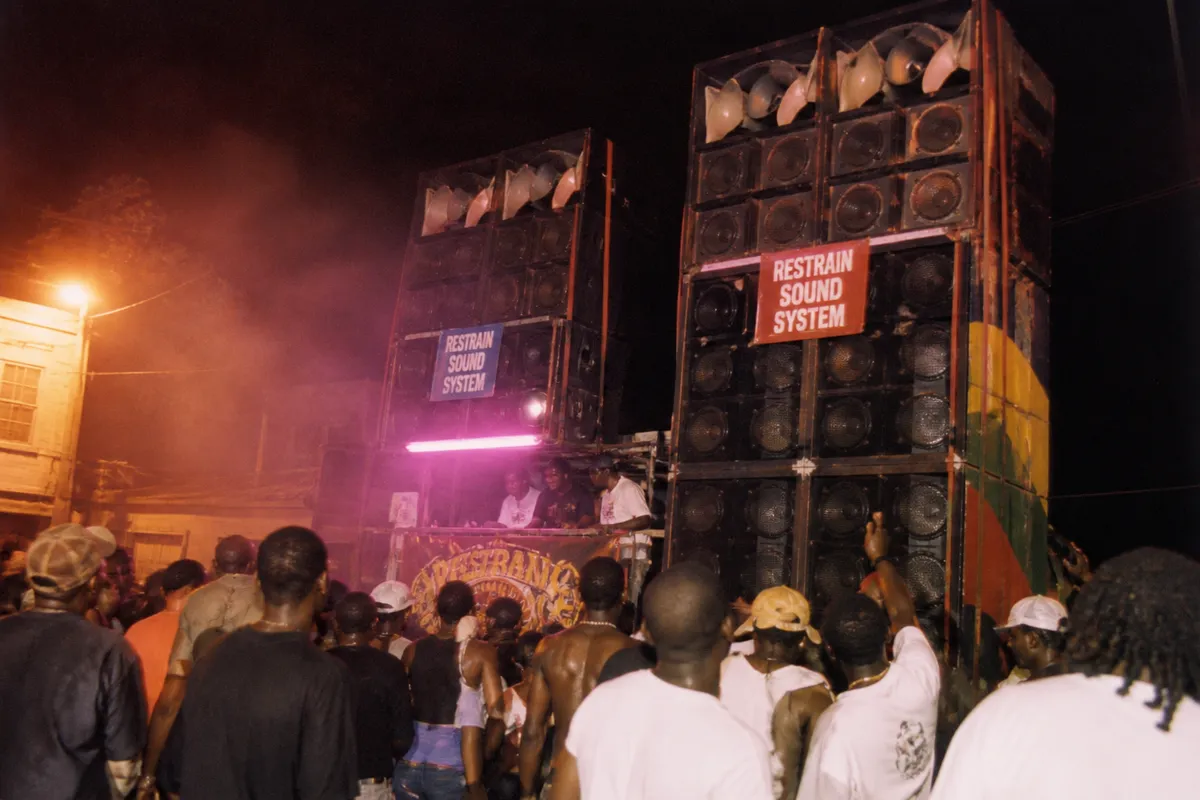
Roseau Carnival is the Bouyon arena in the 2000s. To understand what Triple Kay is and why the band becomes the reference, you have to understand that arena, not as context, but as active frame. Carnival is not a feast. It's a fight.
The ecosystem combines several elements documented in public sources. First element: truck-mounted sound systems. Bands do not play on a fixed stage. They play on a mobile platform that rolls down the streets of downtown Roseau, followed by a crowd that walks, dances, sings. Second element: the annual inter-band competition. Juries and audience together designate the best performances. The verdict is partly formal (juries), partly popular (the crowd that follows the truck that walks best). Third element: setlists built for the crowd. Choruses chanted collectively, simpler structures than studio, energy maintained over duration.
It is in this frame that Triple Kay becomes reference. Not by accident, and not by marketing alone. The band has an observable strategy: singles built for the crowd, choruses that can be chanted back, XL lineup that lets the energy hold for hours. But that strategy is not enough to explain dominance, there is also a properly musical dimension, an architecture in the role division, a rehearsal rigor. The bands that just imitate the surface strategy ("let's make sung choruses") do not become Triple Kay.
That honest reading is the only one that holds when the two camps are confronted. Cornell Phillip is not wrong that 2000s Bouyon shifted toward chant. Triple Kay is not wrong that a band that doesn't think the crowd loses the crowd. The two practice the craft differently. The carnival, itself, votes every year.
The collective machine
If Triple Kay is a stage machine, then the machine has to be described.
The public core: Killa (keys, prod, architecture), Benji (lead vocal), Tazzy (vocal), Sweet Ticky (vocal, internal historian).
The complementary members appear in the band's credits: Kenan, Kurt (bass), Joffrey (drums), Froggy (drums), Nigel "Piping" (keyboard programming), Nico / Miss Aveni, Juan. Their personal trajectory is less publicly documented, but they hold the band across ten kilometers of parade.
Beside the formal core, you find additional voices and associates. Tasha / Stasha (young artist on TK tour), Shelly (guitarist, today the voice of Signal Band). That entourage also produces the era's Bouyon, not as official members, but as stage and studio partners.
The structure deserves to be read as a response to a practical problem. WCK had a five-musician core and a repertoire that had to hold up to listening. Triple Kay arrives with ten members and a repertoire that has to hold up to the truck. The truck imposes logistics, gear, security, coordination, and endurance, multi-hour sets, sometimes multiple trucks per night during carnival peak. With five musicians, it's tight. With ten, it's playable. With ten well-organized, keyboard-architect holding the base, lead vocal driving the choruses, heart-voices taking relays, stable rhythm section, it's dominant.
That explicit role division is the structural signature of the modern band in Bouyon. WCK shared roles more fluidly. Cornell Phillip touched everything, Naye sang and programmed, several members could take vocals depending on the title. Triple Kay codes the division. Killa plays the keys. Benji leads. Tazzy and Sweet Ticky support. The rhythm section holds the pulse. No one wears every hat. And that is precisely what makes the band reproducible across ten kilometers of parade.
That reproducibility has an important collateral effect for the rest of Bouyon. Once the modern band standard is laid, any group that wants to enter the arena has to comply with it, at least partially. That's what we treat in the next section.
The ecosystem: the rival bands of the decade
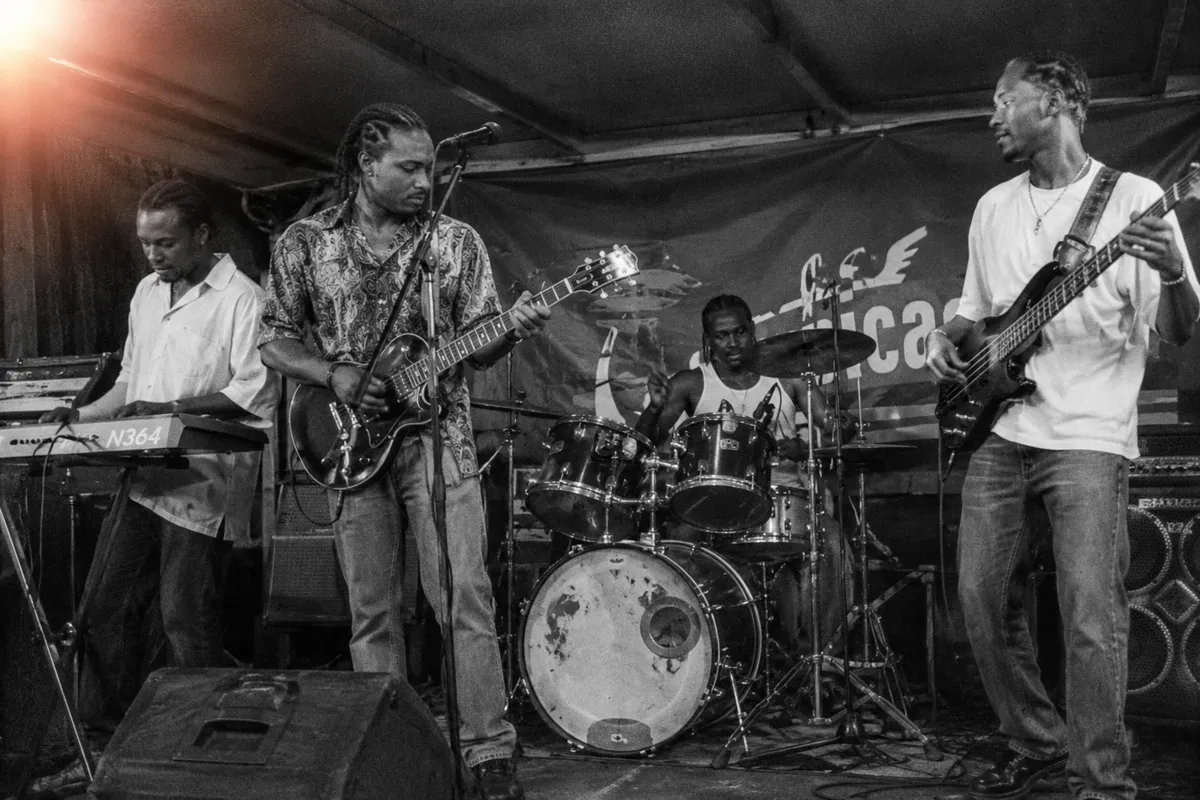
Triple Kay is not alone in the arena, and its reign is not without rivals. Several other bands active in the 2000-2010 decade structure the carnival competition landscape.
A few names that come back across the decade: Effects Band, All Star Band, Cross Vibes Band, Ignition Band, Explosive Band, Legacy Band. These formations leave fewer public traces than Triple Kay, not because they didn't exist, but because their trajectory is less exposed. Several have their own history, their own signatures, and some take part in collective hits known mostly by their choruses rather than by their precise authors.
Two singles come up often in the era's public conversations, without stabilized attribution: 767 and I Love Buy. The credits associated with these singles point to Daddy Peter, Clint, Chad / Trump Dada, Marline / Mareline. These names are not in Triple Kay. The nuance matters: 2000s Bouyon does not have a single producer or a single band. It has a scene with hits in circulation, and Triple Kay holds a dominant place in it without monopolizing it.
Beside the rival bands, you find secondary producers and voices who are not formal Triple Kay members but contribute to the era's sound. Tasha / Stasha, Shelly. They too make 2000s Bouyon, and their work feeds the standard Triple Kay imposes.
That geometry becomes readable when you look at the bands that didn't want to play the Triple Kay game. The wrecketeng line around DJ Cut, Bushtown Clan, Klockerz Krew, Nursery Krew Inc., that's another Dominican story, more raw, more underground, more riddim, that develops parallel to the band decade without being erased but without taking center arena either. That line will have its own chapter. For now, retain that it exists and that it's marked by the Triple Kay decade as much as the bands themselves.
2008-2010: the band hits a ceiling
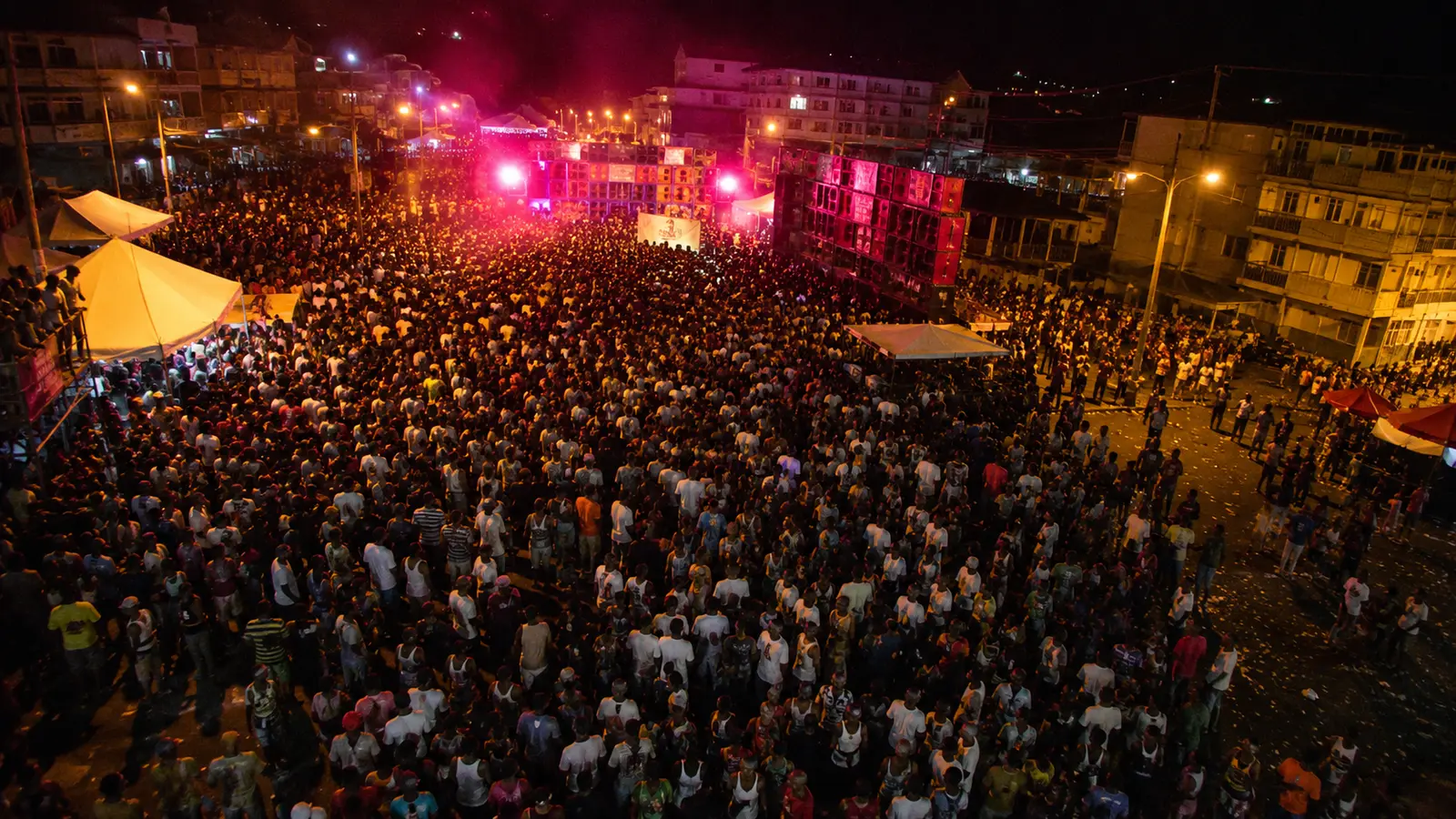
The carnival arena does not empty abruptly. But between 2008 and 2010, something shifts in the relationship between the crowd and the bands. Public sources let us pin a precise moment that crystallizes that transition: Triple Kay's 10th anniversary in 2010.
In a Dominica News Online archive found under the title "band-leader-resigned-in-wake-of-triple-kays-10th-anniversary", the year 2010 is documented as an internal turning point for the band, a band leader publicly resigns after the anniversary. This is not the end of Triple Kay, who will keep existing and producing afterward. But it is the end of a certain purity of reign. The internal crisis becomes public. The moment when you can no longer pretend Triple Kay is an intact machine.
That internal crisis resonates with a larger sentiment in the carnival. The audience wants something other than another band. It wants a solo voice, identifiable, portable outside the arena, a figure followable year-round, not just during the February parade. That demand is not invented by commentators after the fact. It is readable in single play counts, in press comments, in the conversations rising around young voices stepping outside the band frame. The dominant form of Bouyon is in the process of changing, from collective to solo.
This is the historical cue for Asa Bantan's arrival in 2011-2012, which we'll treat frontally in chapter XII. The symbolic title of Bouyon Boss will be attached to Asa Bantan via his eponymous hit, important to say it here, because popular discussions often confuse the collective Triple Kay reign (chapter III) with the solo Bouyon Boss title of Asa Bantan (chapter XII). The two are not the same thing. Triple Kay is the arena. Asa Bantan is the boss who steps out of the arena.
Bouyon laid its language with WCK. It built its arena with Triple Kay. But the arena is starting to empty of the crowd that now wants an individual face. That's the story that opens with Asa Bantan.
FAQ : Triple Kay and the carnival arena in questions
Is Triple Kay the most important band in Bouyon? Over the 2000-2010 decade, yes, in the sense that it's the band that defines the modern Bouyon standard at Roseau Carnival (XL lineup, role division, repertoire built for the truck). But Triple Kay does not invent the genre (that's WCK, chapter II) and is not alone in the arena (Effects, All Star, Cross Vibes, Ignition, Explosive, Legacy also exist). It's the dominant reference, not a monopoly.
Who is Killa exactly, and who is in Triple Kay? Killa is the founder, keyboardist, producer and musical architect of Triple Kay International. The public core is completed by Benji (lead vocal), Tazzy (vocal) and Sweet Ticky (vocal + internal historian, later cultural ambassador appointed by the government of Dominica for Bouyon). More than ten musicians pass through the band's credits.
Why does Triple Kay have ten musicians and not five like WCK? Different mission. WCK is a studio laboratory (five musicians, repertoire for listening). Triple Kay is a stage machine (ten musicians, repertoire for the carnival truck). Ten kilometers of parade in a singing crowd demand a logistics, an endurance and a vocal relief that a five-musician core cannot hold.
What is the "Bouyon Boss" title? A symbolic title attached to Asa Bantan (chapter XII) via his eponymous hit. Not to be confused with the collective Triple Kay reign of the 2000s. Triple Kay is the arena, Asa Bantan is the boss who steps out of the arena with a solo voice. The confusion between the two is frequent in popular discussions.
What does Cornell Phillip mean with "too much chant chant chant in bouyon"? Cornell "Fingers" Phillip is the keyboard-prod architect of the WCK core. In an interview with Dominica News Online, he criticizes the 2000s Bouyon shift toward an aesthetic he sees as too dominated by carnival chant, at the expense of the instrumental + vocal + machine balance. The target is not explicitly Triple Kay, but the aesthetic in question covers exactly what Triple Kay imposes.
Did the Triple Kay reign smother other Bouyon styles? Partly. The Triple Kay dominance over the decade pushed rival aesthetics (wrecketeng, reketeng, Nasty Business around DJ Cut, Bushtown Clan, Klockerz Krew) onto the underground route. They will resurface in the 2020s with DJ Taffy, Tha Wizzard, Smokiller. The reign is not just good or just bad, it has a geometry.
Why does 2010 mark the end of the band decade? Because Triple Kay's 10th anniversary coincides with a public band leader resignation, documented by Dominica News Online. The internal crisis becomes public exactly when the carnival audience starts wanting something other than another band, a solo voice, identifiable, followable year-round. Asa Bantan arrives in 2011-2012 into that demand.
Where can I listen to Triple Kay today? The hits Big Ting, All Out, Sewo, Bubblin circulate on YouTube and streaming platforms. To hear the Triple Kay carnival legacy reinterpreted by the New Bouyon Wave (TIITII NBA, 1T1, Softee, Aknose, Nils, Theomaa, Le Juh, Lucky lukee), head to chapter VII.
